What is a wallet cluster? Alt wallets and wallet clustering
A wallet cluster is a group of wallets run by one trader. Wallet clustering links those alt wallets by SOL sent, shared funders and known groups.
Twelve small buys look like a crowd. Usually it is one person. We learned that the expensive way, right after the twelfth wallet sold.
Clusters drawn live: the Solana wallet clusters map.
Why one trader uses many wallets
A Solana wallet costs nothing to make. No sign-up, no name, no limit. So a serious trader rarely stops at one. They keep a public wallet people can watch, plus alt wallets (alternates) nobody is meant to connect to it.
The reasons are practical:
- Hiding size. One wallet with 6% of a token sits at the top of the holder list. Six wallets with 1% each look like six strangers.
- Beating the copiers. Once a wallet is known, people and bots follow it. An alt nobody watches gets in first.
- Selling out of sight. The public wallet holds. The alts sell into whoever it brought in. This is the one that costs you money. See exit liquidity.
- Keeping things apart. Not every cluster is a scheme. Some traders just run one wallet per strategy.
How wallet clustering works on Solana
Every Solana transaction is public. A wallet has no name, but it leaves a trail: who paid for it, who it pays, what it trades and when. Wallet clustering reads that trail.
clusterz links wallets on three kinds of evidence, strongest first:
- SOL sent between them. One wallet moved SOL straight to the other in a transaction that did nothing else. That points to one person holding both keys. Transfers under 0.02 SOL are ignored, since that is rent, dust or a fee refund. Transfers inside a trade are ignored too, along with tip accounts, which would link everybody to everybody.
- Same funder. Both wallets got their first SOL from the same wallet. A first funding can't be edited later, and it comes before any of the trading. Exchanges and trading terminals don't count, because they fund strangers all day. Neither does a funder shared by more than 8 tracked wallets. Past that it is infrastructure, not a person.
- Same group. Our wallet data holds them as one trader or crew. This is the weakest of the three, because there is no transfer to look up on the chain.
A link is evidence, not proof, and a missing link proves nothing. Fund a wallet through an exchange or a bridge and the first two checks see nothing. Two friends can share a funder.
The cluster buy rule
Linking wallets is half the job. The other half is spotting when they move together.
A Cluster buy fires when enough alts from one cluster each buy the same token for at least $10 within 30 minutes. Enough usually means 3.
The fine print is where it gets useful:
- Only alts count. The main wallet's own buy adds nothing to the count.
- A buy we can't size, such as one paid in another token, does not count.
- By default a wallet only counts if it is not in the red over 7 days, not in the red over 30 days, and has closed at least 3 tokens in those 30 days. A wallet with no score does not pass.
Why wallet clusters matter to a trader
A one-wallet tracker shows you wallets. You are trading against people.
- Head count. Five buyers with the same funder are one buyer. Count them as five and you see demand that isn't there.
- Real position size. Add up a cluster and a holder list that looked spread out can turn into one big bag.
- Direction. One wallet holding tells you little. If the alts are selling, the trader is selling, whatever the public wallet shows.
- Order. Alts first, main wallet last is the setup to know. The main wallet's buy draws the followers, and the alts have someone to sell to.
A cluster buying is a fact, not a buy signal. In our own numbers, a trader in a token through four or more wallets was a bad sign. So the Alpha score takes 4 points off for each one, twice at most. See Alpha score.
Where you see wallet clusters in clusterz
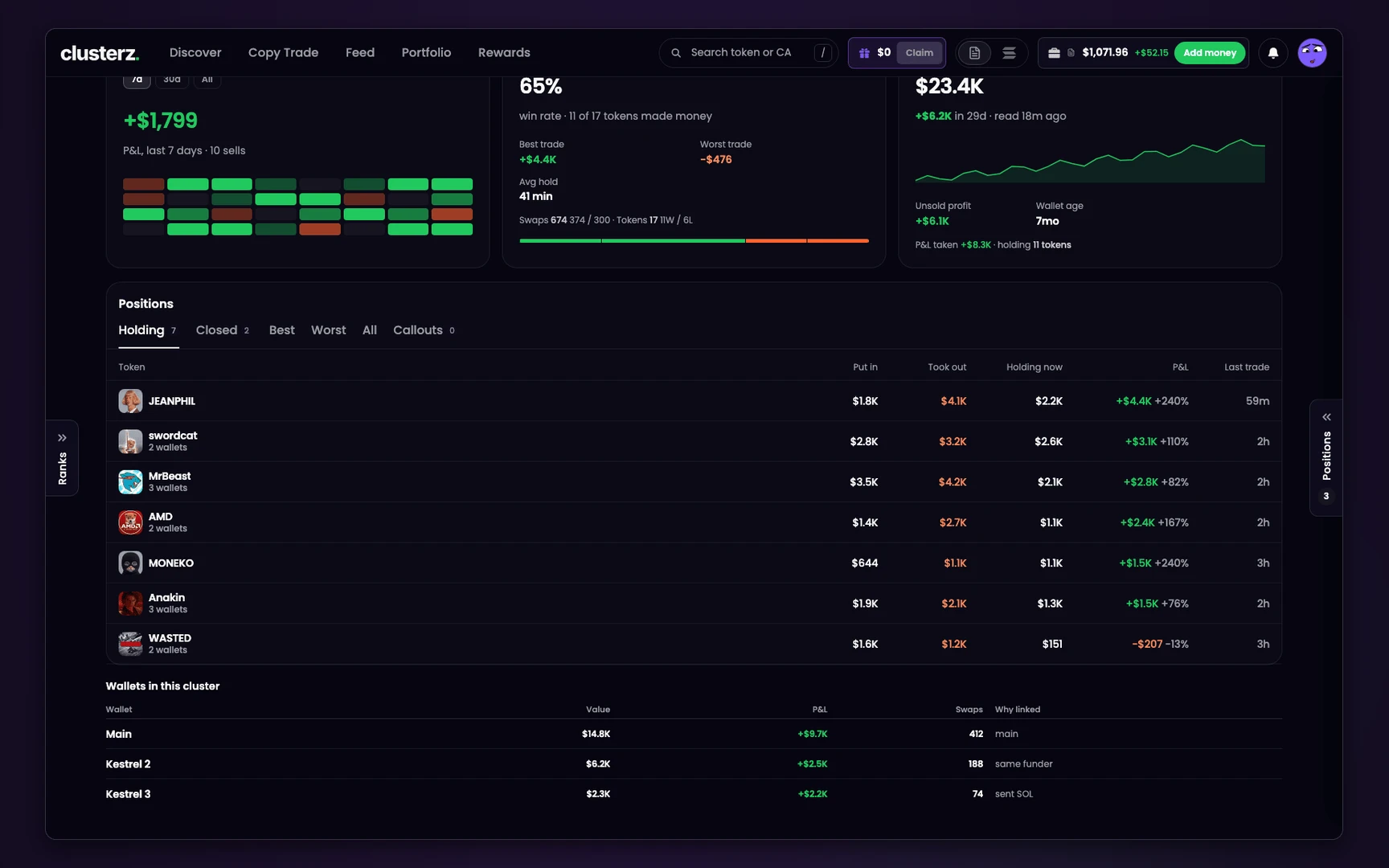 Every wallet in the cluster, and why it is linked.
- Trending tags the token Cluster buy, and the Map gives it a violet glow for up to 4 minutes. A Main wallet in tag marks a cluster's main wallet buying. See The Map.
- A tracked trader's page adds up all their wallets, and Wallets in this cluster gives each one a Why linked: sent SOL, same funder or same group. See Wallets.
- Who's in on a token page shows each tracked trader, how many wallets they run and what they still hold. See Token page.
Clusters only cover wallets we track and links the trail shows. An alt nobody has linked reads as a stranger, so treat a cluster's wallet count as a floor, not the full number.