What is a rug pull? Meaning in crypto and warning signs
A rug pull is when the people behind a token sell or drain it and the price collapses on everyone else. The main types of rug pull and the warning signs.
Every memecoin trader has a rug story. Most of ours start with "it looked fine" and end with a chart that is one red candle tall.
The rug checks on every new pair's card, on one page: pump.fun new pairs, live.
What a rug pull means in crypto
The rug pull meaning is in the picture: the rug gets pulled out from under you. The people with the most control over a token take the money out, and the holders are left with something nobody will buy.
On Solana memecoins a rug is rarely a hack or broken code. It is usually simpler. Someone holds supply they got for almost nothing, or keeps a power the token still gives them, and uses it on the buyers who arrived later.
A rug is not the same as a token going to zero. Most memecoins die because nobody else showed up. A rug has a hand on it.
Types of rug pulls
The words get used loosely. These are the kinds you meet in the trenches.
- Dev dump. The dev holds a big share, often bought at the very bottom of the curve, and sells it into the buyers. One wallet, or a few, and it is over in minutes. This is the most common kind on launchpad tokens.
- Liquidity pull. On a token where the creator set up the pool and kept control of the liquidity, they withdraw it. With no SOL left in the pool there is nothing to sell into. Launchpad tokens trade on the launchpad's own curve first, which no dev can withdraw, so in the trenches this kind is rarer than the dump.
- Soft rug, or slow rug. No single dump. The dev and the early wallets sell a little at a time, the posts stop, the X account goes quiet. The chart bleeds for hours or days. Each sell looks small, which is the point.
- Bundle and insider exits. The cheap supply sits across many wallets that bought at the launch or were funded by the dev. Each sell looks like noise. Together it is one exit. See bundled tokens and snipers.
- Mint or freeze abuse. If the mint authority is still live, the creator can print new tokens and sell them, so your share shrinks. If the freeze authority is live, they can lock your tokens so you cannot sell while they can. See mint and freeze authority.
Most real rugs mix two or three of these. A dev who dumps usually had a bundle doing the same thing a few wallets over.
How a rug pull plays out on a Solana memecoin
The order barely changes:
- Cheap supply ends up in a few hands: the dev's launch buy, a bundle, snipers, wallets the dev funded.
- The token gets attention. A post, a call, a chart that suddenly looks alive.
- Buyers arrive and the price climbs.
- The cheap supply sells into them.
Steps one and four are on the chain for anyone to read. Step two is the part built for you to see. If you bought in step three, you were the exit liquidity.
Why a rug pull matters to a trader
- It is fast. A dev holding 20% of supply can crash a thin pool in one sell. Your stop loss fires after the price already went through it.
- Some rugs stop you selling at all. A frozen account or a token whose transfers are blocked cannot be sold, whatever the chart says.
- It is mostly visible beforehand. Most rugs we got caught in were not hidden. We just did not look at the right line in time.
- There is no refund. A swap on Solana is final. Nobody can reverse it for you.
Rug pull warning signs
These are the signs we read first. The full order, with what to do at each step, is the rug check.
- The creator still has powers. Mint authority live, freeze authority live, or transfers blocked.
- A few wallets own most of it. The top 10 own half the supply or more. See top 10 holders.
- The dev is sitting on a bag, or already selling. Over 20% held, or a dev that sold and kept a lot. See dev wallet.
- The launch was loaded. A bundle or snipers still holding a big share.
- Linked or brand new wallets. Insiders funded from one place, or several fresh wallets in the top 20.
- The dev has done this before. Many launches, none that took off, or a record of rugs.
- Copied identity. A logo, X account, site or Telegram reused from an earlier launch.
- No money in the pool. A big market cap over a tiny pool can be pushed down by a single seller.
- Volume that looks bot-made. See fake volume.
One sign is a reason to read further. Three telling the same story are one big problem, not three small ones.
How clusterz flags rug pulls
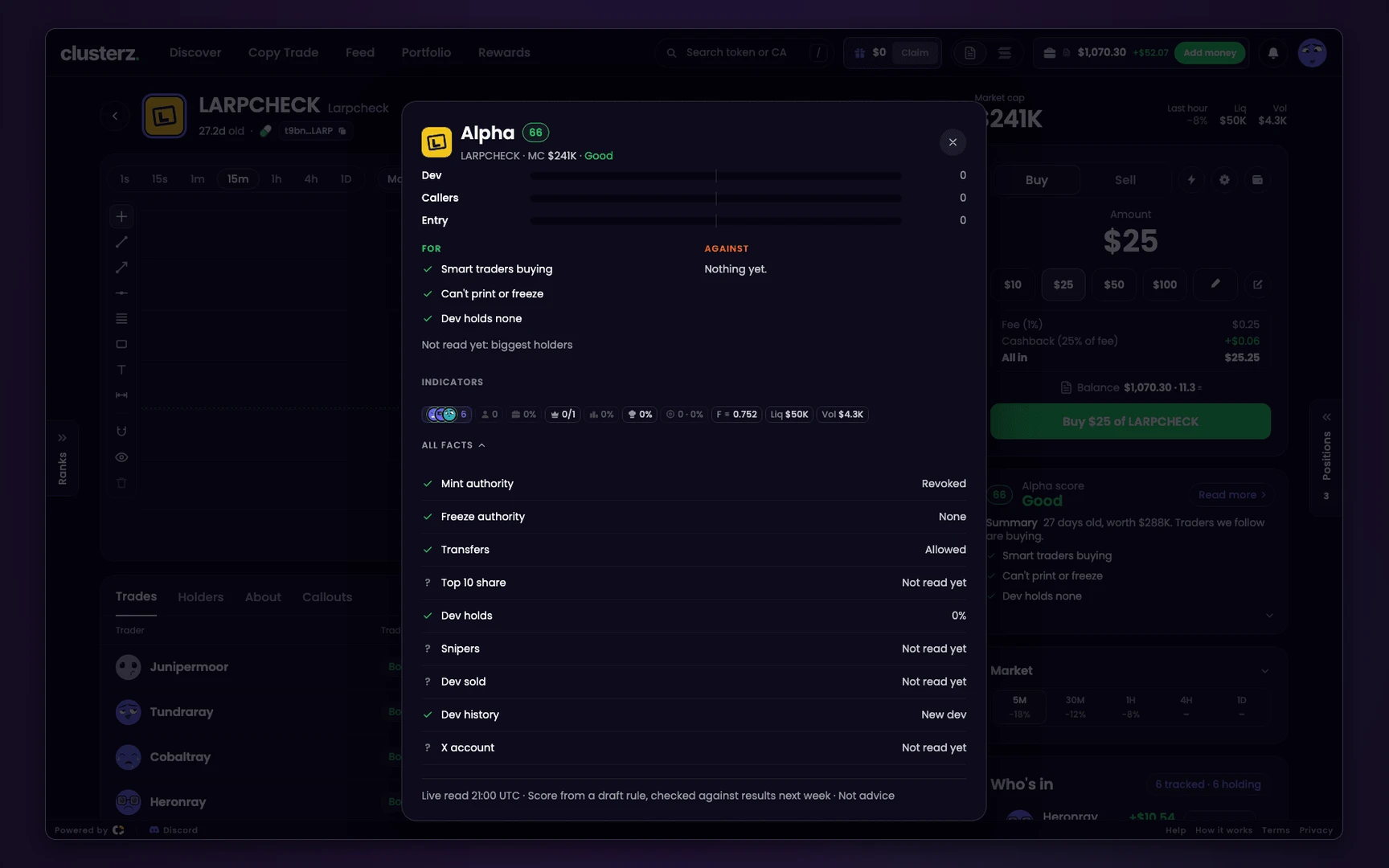 All facts on a token page: mint, freeze, transfers, top 10, dev and snipers.
- Safety checks. On the token page, Read more then All facts lists Mint authority, Freeze authority, Transfers, Top 10 share, Dev holds, Dev sold, Dev history and Snipers. See Token page.
- Red flags. A live mint, a token that can be frozen, the top 10 owning half the supply or more, or a dev holding more than 20% caps the Alpha score at 25, whatever else looks good. Against tags those lines High risk: "Creator can print more", "Your tokens can be frozen", "Top wallets own 54%", "Dev owns a big chunk". See Alpha score.
- The dev pill and DS. The pill on every Trenches card shows the dev's share, and turns into DS once the dev has sold.
- How our record defines a rugged launch. A launch counts as rugged when the dev sold and its last market cap sits 70% or more under its peak. A dev who sells without crashing it does not count.
- The rug-rate rule. A dev with 3 or more earlier launches, at least two in three of them rugged, caps the score at 25. Three or more rugged on record takes 6 points off. Dev rugs in Filters set to 0 hides any dev with a rug on record. See the rug-rate rule.
- Pool drained. A protection rule in your exits: it sells all if the token's pool loses 45% of its liquidity. It is off until you turn it on, and on Live it sells only while a clusterz tab is open. See Exits.
- Copy Trade. Skip a token when lets a copy walk past tokens marked Dev holds a lot, Bundled, Many snipers or Top 10 hold a lot. See Copy Trade.
What none of this catches: a dev selling from a side wallet, tokens moved to another wallet before the sell, a launch nobody tracked has touched yet, and whatever happens in the next ten minutes.
A clean read promises nothing, and none of it is advice.
Rug pull FAQ
What is a soft rug in crypto?
A soft rug is a slow exit with no single dump. The team sells in small pieces, stops posting and lets the token bleed out over hours or days. It is harder to call than a hard rug because no one sell looks big.
Watch the dev's share and the bundle's share fall over time, not the size of each sell.
Is a dev selling always a rug pull?
No. Devs take profit, and a small sell from a dev who still holds little is not the same as a dump.
What matters is how much they still hold and how much the price fell after. On our record a launch only counts as rugged when the dev sold and the market cap ended 70% or more under its peak.
Can you get your money back after a rug pull?
Almost never. A Solana swap is final, and there is no one who can reverse it. That is why the check happens before the buy, not after.
How do you check a token for a rug pull before buying?
Read the creator's powers first, then who holds the supply, then the dev, then the launch wallets, then the pool. Our rug check walks through it in about a minute, and Bundles and insiders covers the launch wallets in depth.