Memecoin trading for beginners: a first-week plan
Memecoin trading for beginners: a seven-day plan that starts on practice money and uses these docs as the syllabus, from reading a token to deciding on Live.
Most launches never graduate, and plenty go to zero. Start there and the rest of the week makes sense.
This is not a way to make money. It is a way to learn what you are looking at before it costs you anything.
Every day uses Practice, play money against the live market, and one or two pages of these docs. Your first buy is in the quick start.
The switch to real SOL is in Practice to Live. This is the week in between. Nothing here is advice.
Your first week can run on play SOL: paper trading memecoins, for free.
How to start trading Solana memecoins: the setup
Before day one, three things:
- Sign in and stay in Practice. The paper icon in the header means Practice. You start with 1,000 USD worth of SOL.
- Pick a size you would trade if this were real, and set it as your Buy presets in Trade settings. Paper sizes teach paper habits.
- Keep a note open. Every trade gets one line: why you bought, where your stop was, how you got out.
 Paper icon for Practice, SOL icon for Live.
The week at a glance
| Day | You learn | Read |
|---|---|---|
| 1 | The words and the risk | Memecoin slang, rug pull, bonding curve |
| 2 | Reading a token | Token page, rug check |
| 3 | The dev and the holders | Dev wallet check, bundles and insiders |
| 4 | Tracked wallets and the Map | The Map, wallet clusters, finding new memecoins early |
| 5 | Exits before the buy | Stop loss, first exit plan |
| 6 | Size and costs | Position sizing, slippage, Fees |
| 7 | Review, then decide | Portfolio and P&L, Practice to Live |
Day 1: learn the words and the risk
Read the slang page so the Feed and the token pages stop sounding like noise. Then read what a rug pull is and how a bonding curve works, because most launches you will see are on one.
Then open Trenches and just watch. New, Soon and Graduated fill and empty in real time. Count how many launches in New ever reach Graduated. No buys today.
Day 2: read a token like a trader
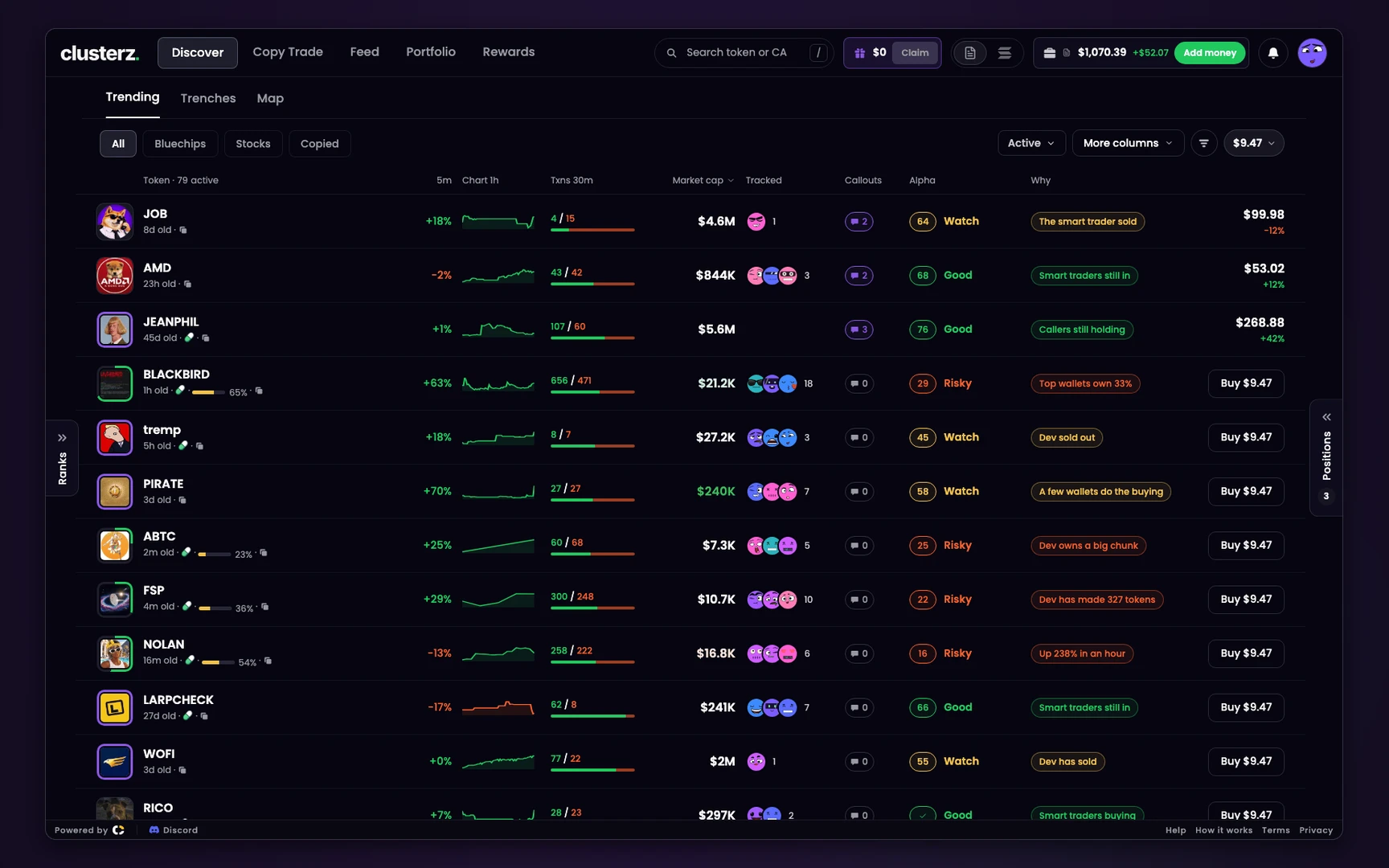
Open the token page guide and keep it beside a real token. Find Market cap, Liq, the Alpha score and Safety. Then run the rug check on five tokens from Trending: mint and freeze, top 10, dev, bundle, snipers, liquidity.
Write one line per token: would you buy, and the one reason. If you buy one in Practice, buy at your preset and nothing more.
Day 3: check the dev and the holders
A token is mostly its holders. Read the dev wallet check: what the dev holds, whether they sold (DS on the pill), who funded them, wallet age and past launches. Then bundles and insiders, and the pill table in holder checks.
Go back to your five tokens from day 2. Did any of them have a pill you missed? That is the lesson.
Day 4: read the Map and the tracked wallets
clusterz is built around tracked wallets and the clusters they trade in. Read The Map and wallet clusters, then KOL wallets and exit liquidity. The last one explains why buying after a public call can make you the trade.
Then read finding new memecoins early and watch the Map for a while. A tracked buy is a reason to look closer, not a safety check. Tracked traders get rugged too.
Day 5: set exits before you buy
Today, nothing gets bought without a way out. Read how to set a stop loss and your first exit plan. Then:
- Open Trade settings and scroll to Exits for new buys.
- Turn on Stop loss, and decide on the take-profit side.
- Press Save. Exits reach new buys only, so set them before the trade.
Make three Practice trades. Each one should show its exits, not "No exits. Only you sell this." Note that Practice exits sell with no tab open and Live ones do not, unless you allow it. See Exits.
Day 6: size small and count the costs
Read position sizing. Work out your planned loss and your worst case per trade, in SOL, for the wallet you would really fund. Then read slippage and Fees.
Every Live trade you place pays our 1% each way, plus the pool's fee and the network.
Trade your plan in Practice: same size, same exits, every time. Change nothing mid-day. If you want to change a rule, write it down for next week. A first-week setup, setting by setting: starter setups.
Day 7: review your P&L, then decide about Live
Open Portfolio and read it honestly. The Portfolio and P&L page says what each figure means.
- Closed: every trade you sold, with Sold for, Change and You put in.
- Stats: Made on sold tokens, Win rate next to Average win and Average loss, Biggest drop and Fees paid.
- The P&L calendar: open your worst day and read Sells that day.
Then hold your week against your notes. Did you skip the rug check on a trade? Buy without exits? Size up after a loss? Those count more than the P&L.
Now the decision. Practice to Live sets the bar: at least 30 closed trades across 15 tokens on one set of rules, still green after Live costs. One week rarely gets you there, and that is fine.
The honest answer on day 7 is usually "another week of Practice". Reset in Account starts the practice money over if you change your rules, but not to hide a bad run.
What a first week cannot teach you
- Real fills. Practice books at once. Live has to land, can fail, and pays more, copies most of all.
- Real nerves. Watching real SOL hit a stop is a different job. Paper cannot show you how you will act.
- A market that is the same next week. What worked for seven days can stop working on the eighth.
- What we cannot see. Side wallets, moved tokens and a dev's other launches can sit outside every check.
A good week on paper is a reason to keep going carefully, not a forecast. None of this promises a result.
Before you send it
- Stay in Practice for the whole week.
- One page a day, one note per trade.
- Exits on every trade from day 5, at a size you chose on day 6.
- Judge the week on banked P&L after costs and on whether you kept your rules.
- Ready for the switch later? Practice to Live is the next step.