What is slippage in crypto? Solana slippage explained
Slippage is the gap between the price you see and the price you get. Your slippage setting caps that gap: past it, the swap fails instead of filling worse.
The price on screen is a quote. By the time your trade lands, someone else has traded. On a fresh memecoin, a lot of someones.
What slippage means in crypto
When you swap SOL for a token, the price is set by the pool or the bonding curve at the moment your trade runs, not the moment you click. Between the two, other trades land first. Each one moves the price.
So every swap carries a limit: the most the price may move against you before the trade gives up. That limit is your slippage tolerance. Set 10% and a buy fills at up to 10% worse than the quote, or not at all.
Two things it is not:
- It is not a fee. Nobody collects your slippage. It is just a worse price.
- It is not a target. A 20% setting does not mean you pay 20% more. It means you accept up to 20% more. Most fills land well inside the limit. Some land right at it.
How slippage works on Solana
A Solana swap is signed with a minimum. On a buy, the least number of tokens you accept for your SOL. On a sell, the least SOL you accept for your tokens. Your slippage setting is how that minimum gets worked out from the quote.
When the trade runs, the program checks the minimum. Enough tokens, the swap goes through. Too few, the whole thing fails and nothing is swapped. You still pay the network fee, because the network did the work of running it.
On a pump.fun curve or a thin pool, prices move fast. A token a few minutes old can jump double digits between two blocks. That is why memecoin traders run wider slippage than anyone swapping a big token like SOL for USDC.
Slippage vs price impact
People mix these up all the time.
- Price impact is what your own trade does to the price. A pool is a pile of SOL and a pile of tokens. Your buy takes tokens out, so each token after the first costs more. The bigger your trade against the pool, the bigger the impact. You know it before you send.
- Slippage is everything that moves the price between quote and fill, other traders included. You don't know it until it lands.
Your tolerance has to cover both. A big buy into a thin pool can eat most of a 10% limit on impact alone, before anyone else trades. See market cap vs liquidity for why thin pools hurt.
Why did my swap fail?
On a memecoin, a swap that fails with nothing bought is usually one of these:
- The price ran past your limit. Others bought before you landed. The trade checked its minimum, came up short, and failed. This is slippage doing its job.
- You were short of SOL for the size plus fees.
- There was nothing to trade against, like a token mid-migration between curve and pool. See bonding curves.
- The network dropped it. Busy blocks, a slow send. That one is about fees and tips, not slippage. See priority fees and Jito tips.
A slippage fail feels like bad luck. Often it saved you from buying a candle that was already vertical.
What slippage to use on Solana
There is no right number. There is a trade off:
- Low (5% or so): better fills when you get them, more failed buys on fast tokens.
- Medium (10% to 20%): where many memecoin traders sit. Most buys go through at a price close to the quote.
- High (30% and up): you almost always fill, and sometimes at a price you would never have clicked.
High slippage has a second cost. Anyone who sees your trade before it lands knows how far you will let the price go. That is the room a sandwich attack works in. A wide limit is an invitation.
What we do: start at 10%, go up only for a token that is moving hard and that we are fine buying worse. Never leave it high by default.
Slippage next to tip, size and exits, by situation: the best settings for trading Solana memecoins.
Why slippage matters to a trader
- Your entry is your P&L. Fill 15% worse and the token has to climb 15% before you are even.
- Sells slip too. On the way out, everyone is selling at once. The quote you saw a second ago is gone. A tight limit on a sell can leave you holding while it drops.
- Failed trades cost money. Every failed Live trade still pays the network fee.
- Small pools amplify everything. The same 0.5 SOL that barely moves a deep pool can move a fresh launch hard.
Where you set slippage in clusterz
We call it Max price move, because that is what it is. It sits in Trade settings, the gear on a token page. See Trade settings.
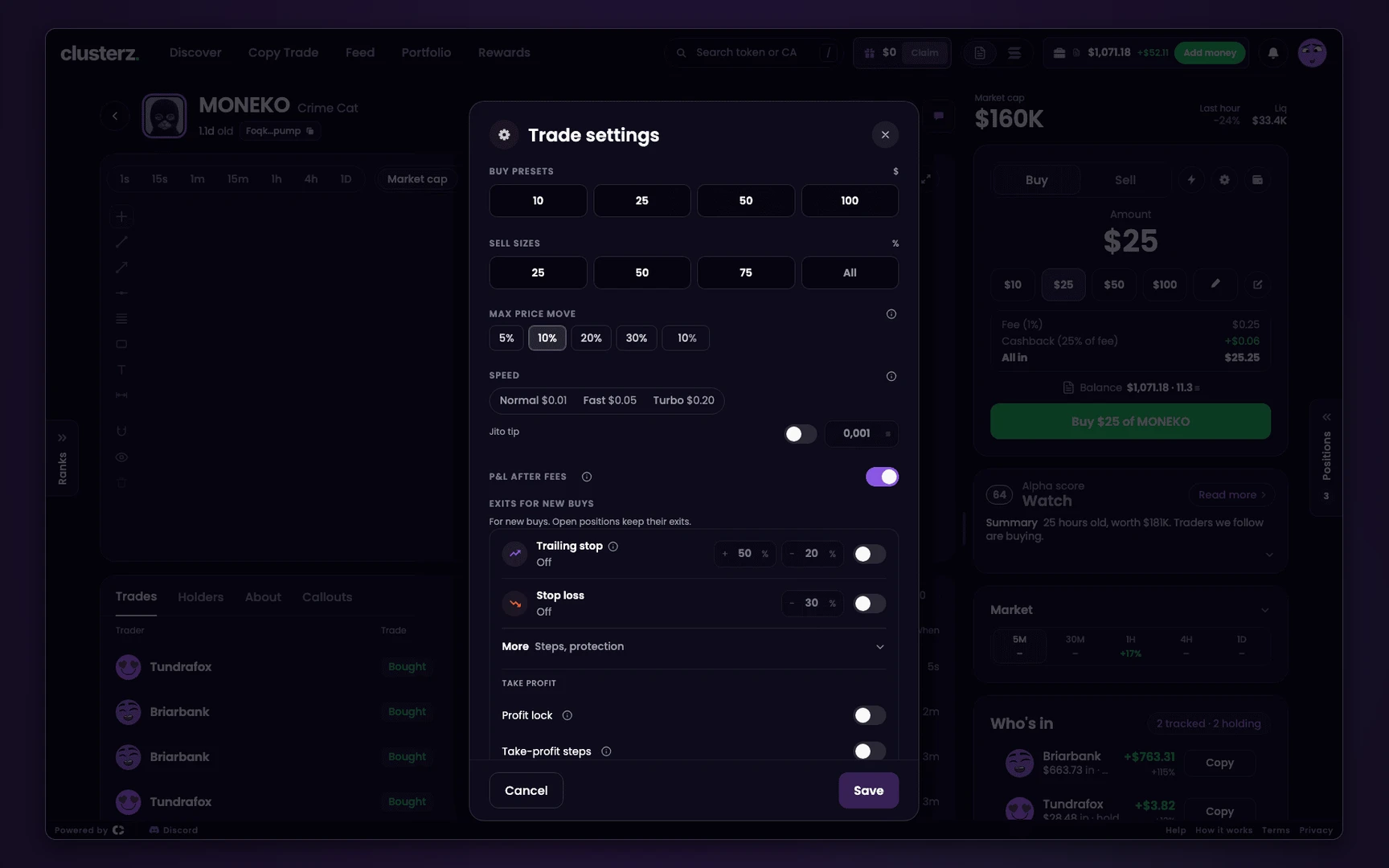 Trade settings: Max price move is the slippage, set once.
- Pick 5%, 10%, 20% or 30%, or type your own value, up to 100%.
- The default is 10%.
- Above 25% the field turns amber: a fill can be far worse than the price you see.
- It applies to Live trades. Press Save to keep it.
When a Live buy fails on price, the toast says so: "price moved past your slippage". A network fee was paid and nothing was bought. See Why did my buy fail?
Copies have their own setting. In a copy's More settings it is called Slippage and starts at 20%.
A copy that pauses after 3 failed buys in a row can suggest more slippage as the fix. Take it only if those buys were worth chasing. See Copy Trade.
The glossary has the short version: Max price move. When to change it, next to every other setting: Settings explained.
Slippage FAQ
What does slippage mean in crypto?
Slippage is the difference between the price you were quoted and the price your swap actually filled at.
Your slippage tolerance is the most you allow that difference to be. If the price moves further before your trade lands, the swap fails instead.
What slippage should I use on Solana memecoins?
Many traders run 10% to 20% on memecoins and go higher only on tokens moving very fast. Lower means more failed buys, higher means worse fills and more room for a sandwich. clusterz starts you at 10% and turns the setting amber above 25%.
Is slippage the same as price impact?
No. Price impact is the move your own trade causes in the pool, and you can see it coming from the pool's size. Slippage is the total move between quote and fill, including everyone who traded before you. Your tolerance has to cover both.
Why did my swap fail with a slippage error?
The price moved past your limit before your trade ran, so the program refused to fill it. Nothing was swapped, but the network fee was paid. Try once more, and raise the limit only if you accept the worse price.
Do I lose money if a swap fails on slippage?
You lose the network fee, not your SOL. The swap itself never happened. Many failed trades in a row add up, which is one reason not to spam a token that is running.