Find insider wallets on Solana: wallet clustering
Find insider wallets and smart money on Solana with wallet clustering: use the Map, cluster buys, wallet pages and Ranks, then check if they already sold.
Nobody hands you an insider list, and neither do we. There is no insider tab. Tracked traders have a record, not a confession. What you can find is who moves first, on how many wallets, and whether they are still in.
Being early beats being told. Being told usually means you are the exit.
Linked wallets drawn as clusters, live: the Solana wallet clusters map.
Two kinds of insider
- Wallets that loaded one launch. These are mostly strangers. The Insiders pill counts them and does not name them. That job is in Bundles and insiders.
- Tracked traders who keep getting in early. These have pages, records and receipts. That is this guide.
Wallet clustering: how linked wallets are decided
Serious traders split buys across a stack of wallets. clusterz links them into one cluster, so five small buys read as one trader. Every linked wallet carries its reason under Why linked on the wallet page:
- sent SOL: SOL moved directly between the two. This is the strongest of the three, because it points at one owner. Dust under 0.02 SOL does not count.
- same funder: one wallet paid for both. An exchange does not count, because exchanges fund everybody. Neither do terminal wallets, or any funder behind more than 8 tracked wallets. That is plumbing, not a person.
- same group: our wallet data holds them as one trader or crew. There is no transfer to look up on the chain, so it is the softest of the three.
A link is evidence, not proof. Read the reason, not just the wallet count.
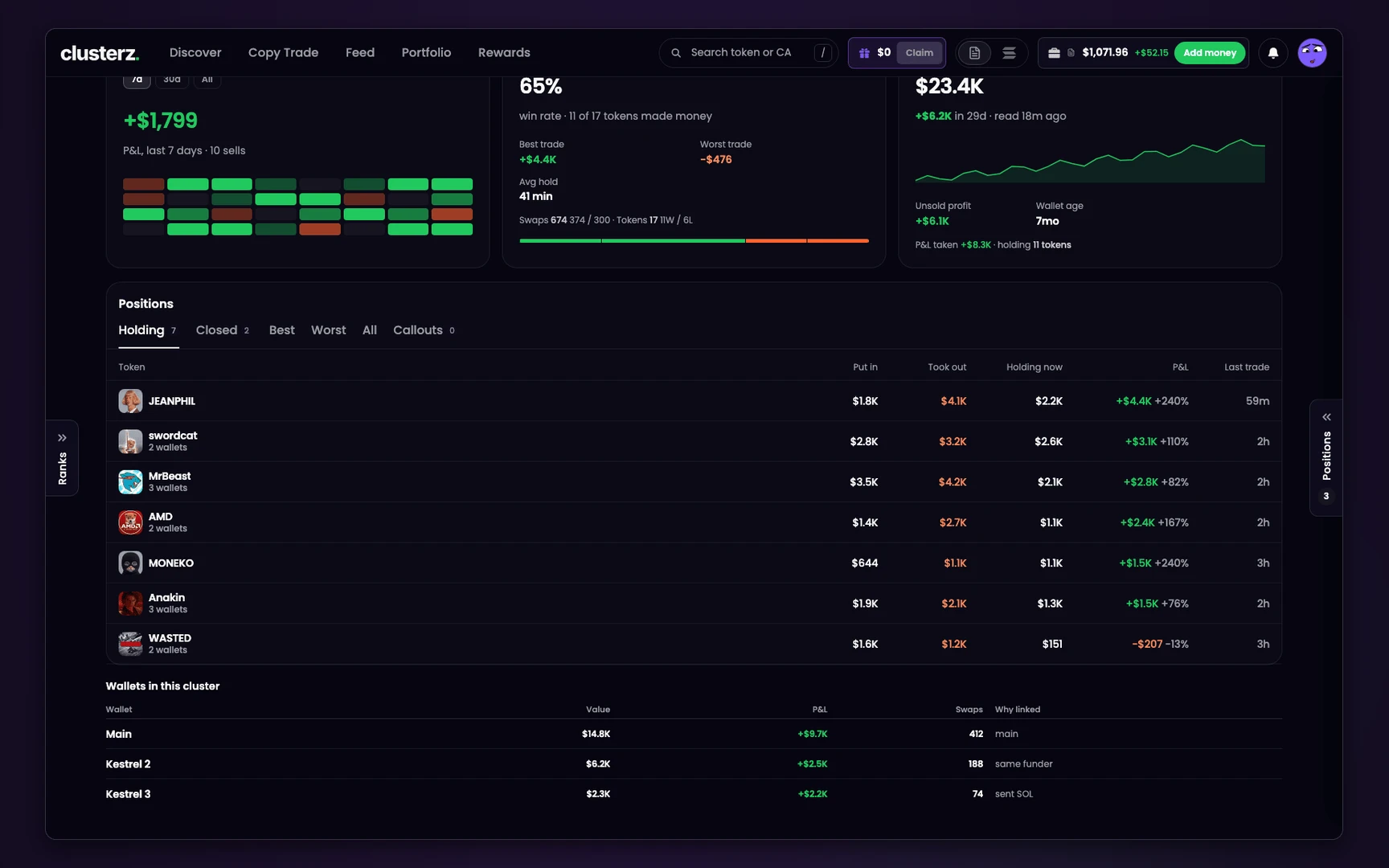 Positions above, Why linked below. Sample data.
Wallet cluster checker: the method
- Catch the move on the Map. Hunt the violet glow. That is a Cluster buy: usually 3 wallets from one cluster, $10 or more each, inside 30 minutes, and wallets in the red do not count. How it fires.
- Watch the main wallet. An orange Main wallet in tag means the cluster's public wallet bought behind alts that were already in. Ask who that public buy is for, and watch which way the lines turn.
- Open the token and read the order. Who's in shows each trader, what they put in, what they hold and on how many wallets. In the Trades tab, pick Cluster and read Market cap then. Whoever keeps appearing at the bottom of the chart is who you came for.
- Open the trader. Click the name. The line under it gives the cluster, the wallet count, the style and how many accounts copy them. BUNDLER marks a quarter or more of their buys inside 60 seconds of launch. Sniper marks 35% or more inside 5 minutes. Both are worth a second look.
- Check the cluster. Scroll to Wallets in this cluster. Three wallets on sent SOL are very likely one trader. Twelve on same group are a softer read. A token row marked "3 wallets" under Positions is one bet, not three.
- Line them up on Ranks. On Ranks, keep the Everyone board and change Sort. Edge is average return per closed position, and needs at least 5 of them. 1st in is how often they beat other tracked traders into a token. That is the closest thing here to an insider's fingerprint.
Smart money on Solana: read them before you follow
A high Win alone flatters. Plenty of traders win small and lose big. On the wallet page, in this order:
- Results: read 30d next to 7d. Anyone looks like a genius for a week.
- win rate: read the count behind it. "12 of 20 tokens made money" says more than "3 of 4 tokens made money". Thin records lie.
- Best trade against the rest: one moonshot can carry a whole page. Check the five bands from >500% to <-50%. A trader who only pays in the top band is a lottery ticket.
- Avg hold: if they hold for less time than you take to read this line, you cannot follow them by hand.
- First 10s: how often they were the first tracked wallet into a cluster buy. Early and profitable together is what you want. Early alone can be a bot.
- Wallet age: a trader who appeared last month has one market behind them.
- "Same funder as 4 tracked wallets": in orange on the wallet card on the Map. More wallets may be theirs than the page shows.
A dash means no data, not a clean record.
Check whether they already sold
Do this last, and every time. The name is worth nothing if they are out.
- On the token: the head of Who's in reads like "6 tracked · 2 holding". Rows marked Sold are gone. Against says "Smart traders sold" when nobody is left.
- On the wallet page: under Positions, compare Put in, Took out and Holding now. A token missing from Holding and sitting in Closed is finished. Took out above Put in means they already have their money back. Their risk is gone. Yours just started.
- On the Map: green lines turning orange while the glow is still on means they are selling into the followers. That can be you.
Happy with all of it? Follow to watch them, or the Copy button with their name on it to ride. See Copy Trade.
What this cannot catch
- Wallets we do not track. The real insider on a launch may never reach the tracked list. The Map only draws tracked wallets.
- Alts we have not linked. A trader's new wallet reads as someone else until a link shows up. One trader can look like two who agree.
- Buying for show. A trader who knows people watch a wallet can use that wallet to bring buyers in.
- The future. A good record is the past. Tracked traders get it wrong, and some will sell to their own followers. None of this is advice.
Before you send it
- Read Why linked, not just the wallet count.
- Read 30d next to 7d, and the count behind the win rate.
- Check Holding before you buy what they bought.
- Five wallets on one token is one trader, not five opinions.
- Run the token through a rug check anyway. Smart money gets rugged too.