Fake volume in crypto: wash trading on memecoins explained
Fake volume is trading done to make a token look busy, by bots or by its own holders. Wash trading on memecoins, volume bots on Solana and how to spot it.
Volume is the number people trust most and check least. It is also the easiest one to buy.
What fake volume means in crypto
Volume is how much a token traded over a window: every buy and every sell, added up. Fake volume is trading whose purpose is the number itself. Nobody is betting on the token. Somebody is paying to make it look like a lot of people are.
The point is attention. Screeners rank by volume, trending lists rank by volume, and traders read a busy chart as demand.
A token doing a million in volume with no real buyers looks the same, at a glance, as one doing a million with thousands.
Wash trading on memecoins
Wash trading is buying and selling with yourself. The same person, often across several wallets, buys and sells the same token back and forth. Money barely moves. Volume piles up.
On memecoins it is cheap. A launch trades against a bonding curve or a pool that anyone can hit at any size.
A buy and a sell of the same amount costs only the fees and a little slippage. Do it a few hundred times and a dead token reads as alive.
Volume bots on Solana
A volume bot is a program, often sold as a service, that runs the wash trade for you. It spins up wallets, funds them, and buys and sells on a schedule. The tells come from how cheap it has to be:
- Same sizes. The bot buys a fixed amount, or a narrow band of amounts, again and again.
- Same few wallets. A handful of wallets do most of the buying.
- In and out. A wallet buys, then sells it back within a minute. Round trip after round trip.
- A steady beat. Trades arrive at regular intervals, day and night, whatever the price does.
Some bots spread the trades over many fresh wallets to dodge the second tell. They usually pay for it in the first and the third.
Why fake volume matters to a trader
- Volume is not demand. Fake trades buy nothing to hold. When the bot stops, so does the chart.
- It hides how thin the market is. A token can trade a fortune in volume over a small pool. Your sell meets the pool, not the volume.
- It lands tokens on lists. Trending slots and volume sorts are exactly what it is built to win. If you found a token there, ask who paid for the trip.
- It costs the faker fees. Somebody spent real SOL on those fees. They plan to get it back, and the plan usually involves your buy.
How to spot fake volume
Without any tool, read the trades, not the total:
- Open the trades list. Many buys of the same size, back to back, is the first tell.
- Count the wallets. If the same few addresses keep showing up on both sides, it is a loop.
- Look for quick flips. A wallet that buys and sells inside a minute, over and over, is not trading the token.
- Compare volume to holders. Big volume with a holder count that barely moves means the same wallets are trading.
- Compare volume to the pool. Volume many times the pool every hour, with no price trend, is churn.
None of these alone proves anything. Real launches get bursts of same-size bot buys too. Two or three together are worth acting on.
How clusterz reads fake volume
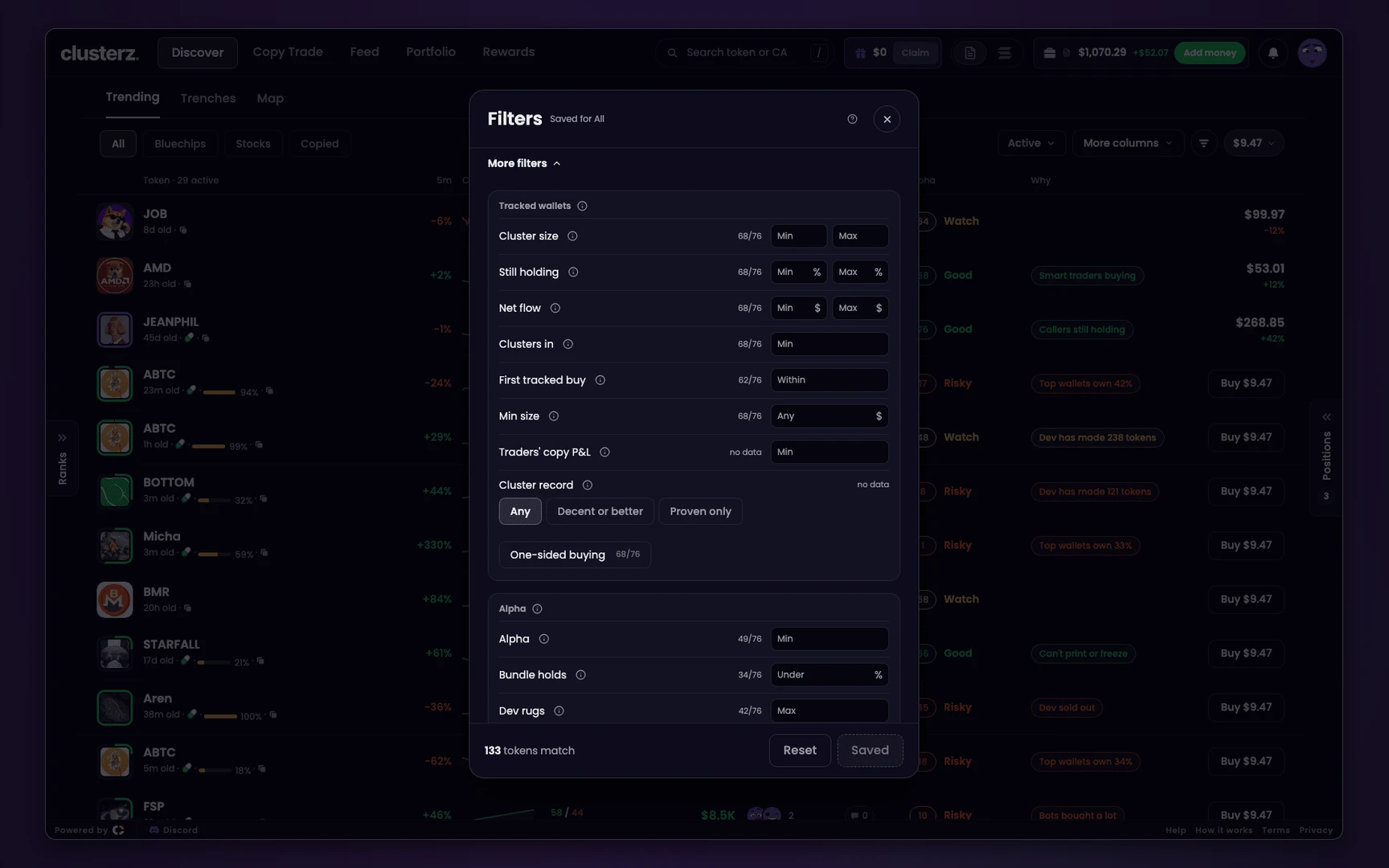 Filters: No fake volume sits with the switches in the short set.
We read the last few minutes of a token's trades from our own tape, and only once there are enough trades in it to judge. Three signs are checked:
- Same-size buys. A large share of the buys are the same size, within a few percent.
- Few buyers. The three biggest buyers make up a large share of the SOL bought.
- Round trips. Many wallets sold within a minute of their own buy.
Two of the three and the token reads as fake volume. Each sign alone is too common to flag on its own. A token is re-read at most every 30 seconds.
What it changes:
- The reason line. Against reads "Looks like fake volume", with the figure under it, like "31% of trades the same size". Read clean on enough trades, For can read "Real buyers, lots of them".
- A few wallets do the buying. This line shows by itself whenever the top three buyers make up a large share of the buys, like "3 wallets, 47% of buys", even if the token is not flagged.
- The Alpha score. Fake volume takes 4 points off in the Real trading group. When that group took points, the sheet can also say "Fake-looking volume". See Alpha score.
- The filter. No fake volume in Filters hides tokens we read as fake. Tokens not read yet stay. See Discover. Our Graduated launches with real volume setup uses it.
- Pro traders. On a Trenches card, the pill turns green when 30% or more of the volume came through trading terminals. It is not a fake-volume check, only a hint at who is trading.
What this cannot catch: a token our tape does not trade, a window with too few trades, a careful bot that varies its sizes and spreads its wallets, and wash trading done slowly over hours.
No flag is not proof the volume is real, and a token can have real volume and still rug. None of this is advice.
Fake volume FAQ
What is fake volume in crypto?
Trading done to inflate a token's volume rather than to hold it, usually by bots or by the token's own holders trading with themselves. It makes a token look in demand so it climbs screeners and trending lists.
What is wash trading on memecoins?
Buying and selling the same token with yourself, often across several wallets, so volume rises while almost no money changes hands. On memecoins it is cheap, because a buy and a matching sell only cost fees and slippage.
How do you spot fake volume on Solana?
Look for many buys of the same size, the same few wallets doing most of the buying, and wallets that buy and sell inside a minute.
On clusterz, "Looks like fake volume" under Against means two of those three signs fired in the last few minutes.
Do volume bots mean a token is a scam?
Not always. Some teams pay for volume to get noticed and still build something. But fake volume always means the chart is lying about demand, so read the holders, the dev and the pool as if the volume were not there.