Alpha score
We aped plenty of tokens that looked clean on the chart and were cooked underneath. Dev sitting on a fat bag. Bundles holding the supply. Callers already out while their post was still going round.
So every token on screen that tracked wallets or callers are in gets one number. The Alpha score is a number from 1 to 99 for how the token stacks up right now, with the reasons sitting right next to it.
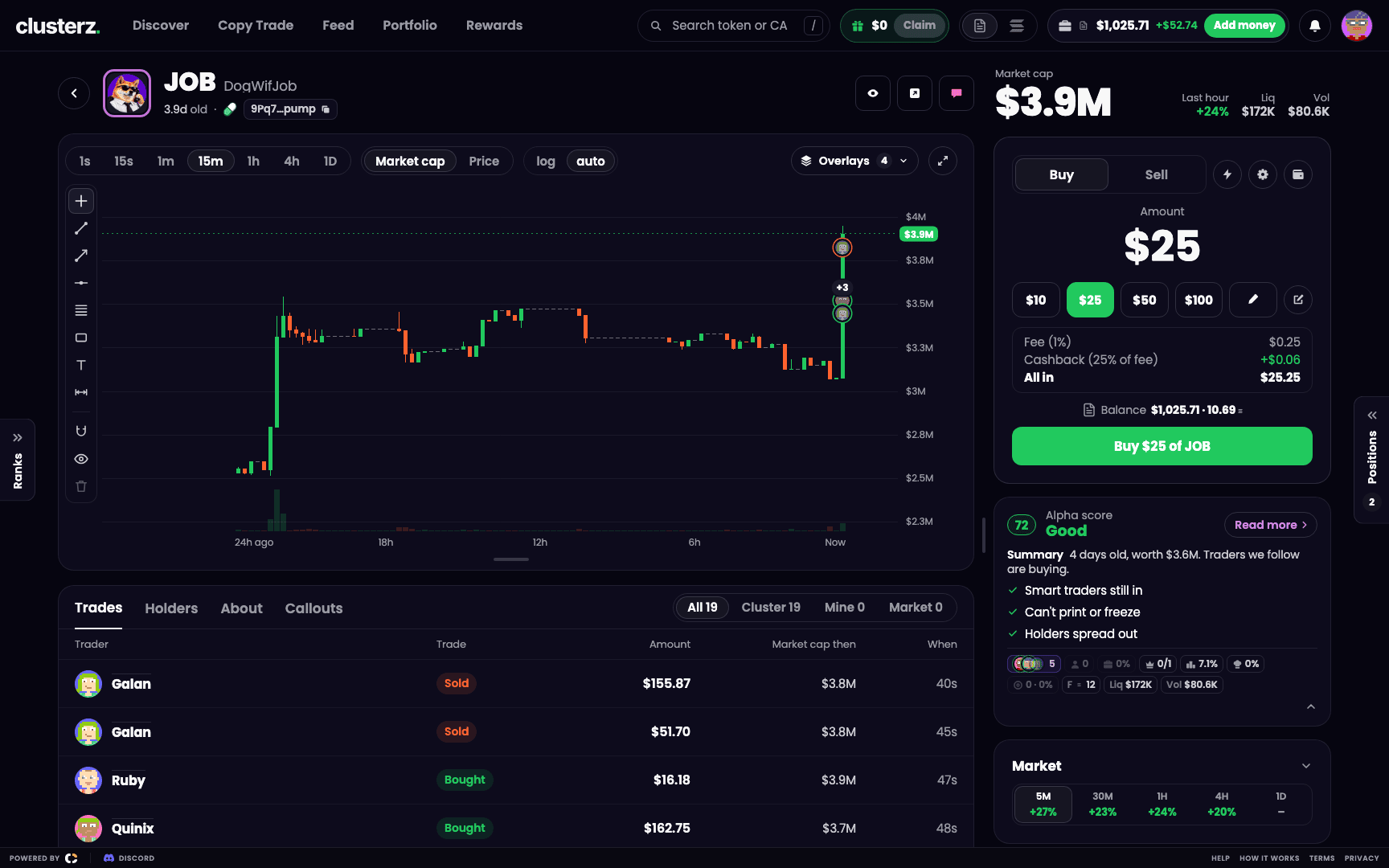 The Alpha score on a token page: the score, the word, the summary and the top three reasons.
The number in one line
Higher means more is going for the token than against it, right now. That is all it means.
Every score sits in a band, and the band gives the word you see everywhere:
- Good: 65 and up.
- Watch: 40 to 64.
- Risky: under 40.
Green, amber, red. Same colours on every surface.
What feeds it
Every token starts at 50. Points get added or taken off in seven groups. The full sheet shows each group as a bar, so you can see exactly what moved it.
| Group | Adds points for | Takes points off for |
|---|---|---|
| Smart traders | Tracked traders still holding (up to +16), KOLs in (up to +8), smart traders in (up to +12), a whale who bought $5,000 or more (+4) | Each tracked trader in it through four or more wallets (-10 each) |
| Holders | Top 10 wallets own under 30% (+2), 150 holders or more (+2) | Top 10 own 30% to 50% (-12), bots that bought in the first 60 seconds got more than 20% of the supply (-12), the launch bundle got more than 20% (-12) |
| Dev | Dev fees of 2 SOL or more (+4), DexScreener paid (+6) | Dev sold (-6), dev wallet first funded in the last 24 hours (-6), dev made more than 10 tokens, or 3 or more with none graduated (-6) |
| Momentum | Up more than 20% in the hour (+4), the last 5 minutes trading at least twice the pace of the 25 minutes before, with buys at least half the trades (+4) | Down more than 20% in the hour (-4), volume at half the prior pace or less (-4) |
| Callers | Anyone called it (+2), callers lean bullish (+4) | Callers lean bearish (-6), 3 or more callers hyped it then sold, and that is at least half of everyone who called it (-8) |
| Real trading | Volume that looks bot-made (-10) | |
| Red flags | Caps the whole score at 25 |
In plain words: tracked-wallet buying, how the holders are spread, the dev's record, how fast it is moving, what callers are saying and doing, and whether the volume is real.
Look at that first row again. One tracked trader in through four or more wallets costs 10 points. That is the same trick that kept dumping on us. Here it counts against the token.
Red flags override everything. Any one of these and the score cannot go above 25, however good the rest looks:
- The mint is still on. The creator can print more.
- The token can be frozen.
- The top 10 wallets own half the supply or more.
- The dev holds more than 20%.
- The dev has 3 or more earlier launches and at least two in three of them rugged.
- Tracked traders sold more than 1.5 times what they bought, and more than $200.
- Tracked traders bought under $50 between them. Dust is not conviction.
The score updates live. A token is re-scored at most every 30 seconds, and only when something about it changed.
No tracked trader and no caller in the token means no score. You get the Safety word alone instead, or Not checked yet when nothing has been read.
Where you see it
You don't go looking for it. It rides along with the token.
- Token page: the card on the right leads with the score, its word and the label Alpha score. See Token page.
- Trending: the Alpha column shows the score and its word, and the Why column shows the top reason. Sort by Alpha to put the highest on top. Unscored tokens sort last.
- Map: a token's tile can carry a small pin with its score, coloured by band.
- Cards: the token card shows the score. Small cards in the Feed show a pill such as Alpha 66 (the figure alone on a phone). Cards in Trenches show the figure alone.
- Filters: the short set has Alpha, at least with Any, 40+, 65+ and 80+. The full panel has an Alpha minimum.
- On a phone: the list shows the score and its word, and the token page puts the card under the chart.
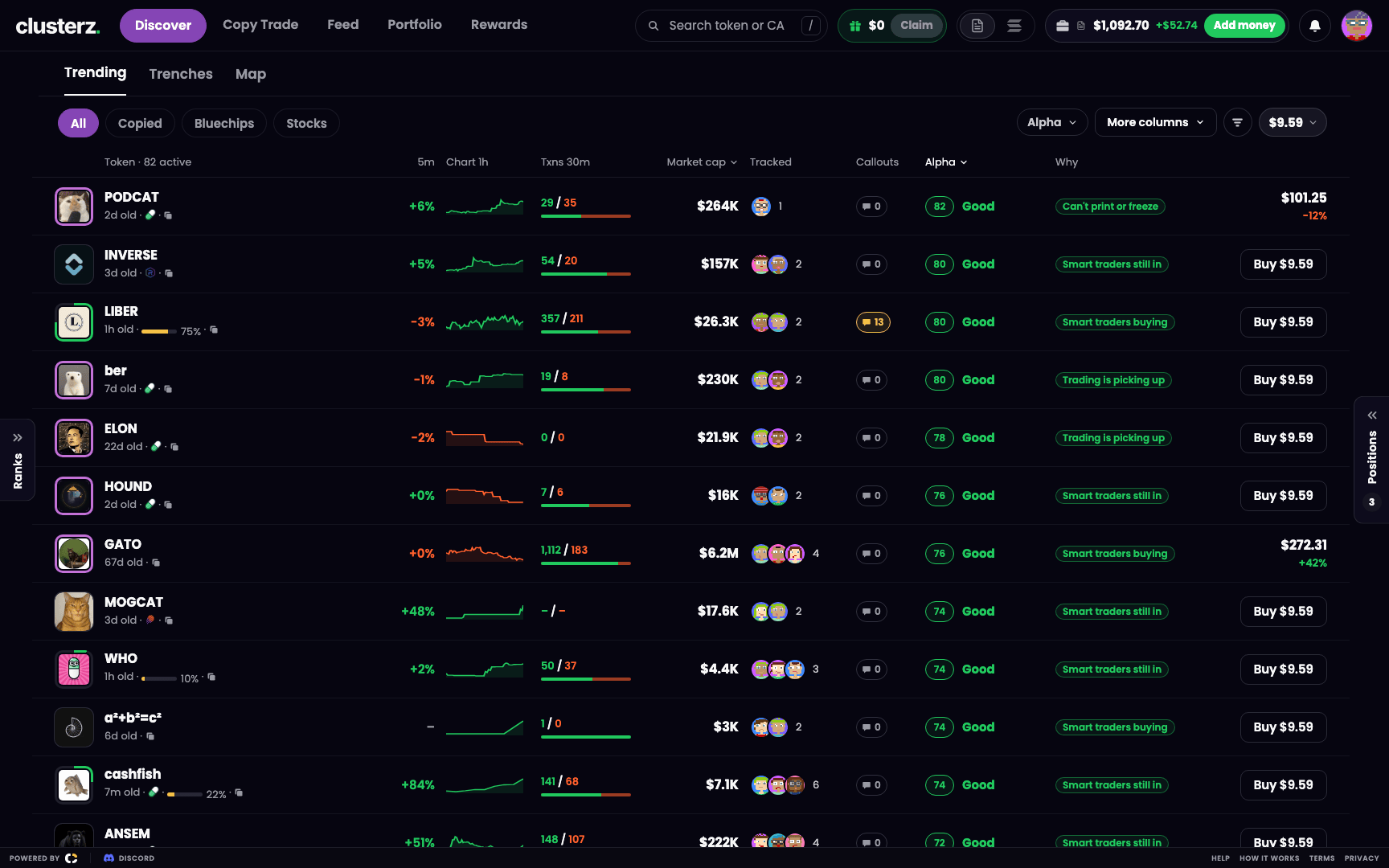 Trending with the Alpha and Why columns. Every scored token read without opening a single chart.
Holding or watching a token and its word flips? You get one toast with the token, its new score and word (like "dropped to 38, Risky") and the leading reason. Only when the word changes, never for the number alone. At most once per token every ten minutes. No spam while you are trying to trade.
Reading the reasons
Under the score you get a short Summary (one or two sentences) and up to three reasons. Short, plain, no jargon. A green tick is a reason for. A ! is a reason against, red when it is heavy, amber when it is light. A ? is a check not read yet.
The summary says how old and how big, then the one thing that matters most. Like "41 hours old, worth $215K. Traders we follow are buying." Or "Callers hyped it, then sold." Or "Almost no money in the pool."
Which reasons lead depends on the band:
- Risky leads with the heaviest reasons against.
- Watch shows two against, then the best one for.
- Good leads with the reasons for.
Click the score or Read more for the full sheet: What makes the score (the seven bars), For and Against with the figure behind a line where there is one, Indicators and All facts.
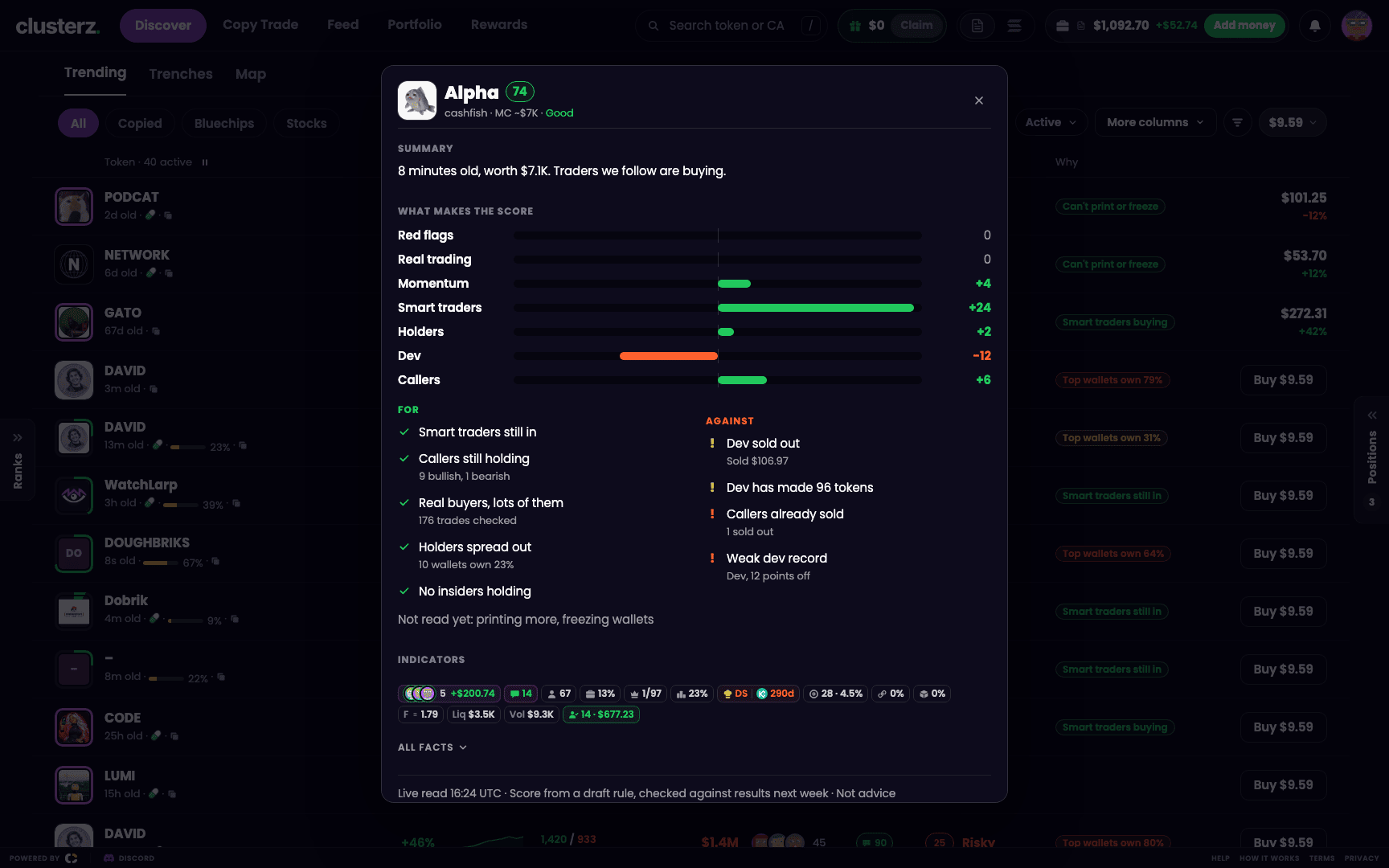 The full sheet: points by group, every reason for and against, and every safety check.
Reasons for, as the app writes them:
- "Smart traders buying", "A smart trader bought", "Smart traders still in"
- "Callers still holding", "Callers are bullish", "Callers posted it"
- "Real buyers, lots of them", "Trading is picking up", "Up 64% in an hour"
- "Can't print or freeze", "Holders spread out", "Dev holds none", "Dev has past hits", "No bots or insiders holding", "Pro traders are trading it", "DexScreener paid"
Reasons against:
- "Smart traders sold", "The smart trader sold", "Smart traders selling"
- "Callers hyped, then sold", "Callers already sold", "Callers are bearish"
- "Looks like fake volume", "Fake-looking volume", "A few wallets do the buying", "Trading is fading", "Volume fading"
- "Creator can print more", "Your tokens can be frozen", "You can't sell it", "Top wallets own 54%"
- "Dev owns a big chunk", "Dev sold, still holds lots", "Brand new dev wallet", "Dev has made 40 tokens", "Dev's tokens never took off", "Weak dev record"
- "Bots bought most", "Linked wallets own a lot", "Insiders bought at launch", "New wallets among top holders"
- "Logo copied from elsewhere", "Links copied from elsewhere", "Its X is borrowed"
- "Red flag caps it"
The figures in those lines are examples. Yours show the token's real ones.
Two rules keep the reasons honest:
- A reason for is dropped when the group it speaks for lost points. No "Holders spread out" on a token the holders group marked down.
- A score under 65 leads with what is against it. If no single line explains it, the group that took the most points off becomes the reason. The sheet's Against lists every group that took points off, such as "Holders, 12 points off".
A mid token doesn't get to sell itself on its one nice line.
Safety and the SI read
Three reads sit together on a token. They do different jobs.
Safety is the checks on the token itself: mint, freeze, transfers, top 10, dev holding, dev history, bots, insiders, the X account. It gives a word with no number. A token with no Alpha score shows the Safety word alone. Once a score arrives, the word comes from the score's band, and the safety checks still show up as reasons and under All facts.
Hide risky tokens in Filters uses the safety checks, not the score. It hides a token when the mint is still on, it can be frozen, it can't be transferred, the top 10 own more than 30%, or the dev holds more than 20%. One switch and the obvious traps leave the list.
The SI read is the token written up in plain words: a score from 0 to 100, a verdict (Enter, Skip, Hold or Exit), the reasoning, risks to watch and an exit plan marked Advisory, not applied until you use it. Press Get a read while signed in. Trending can sort by SI.
The difference:
- The Alpha score is rules and points. Same facts in, same number out, live.
- The SI read is a written take, made when you ask, and redone on its own for tokens on screen and when a held token moves hard. It can be refused, for example "Not read: too little bought" or "Daily limit reached".
- On the Alpha card the Alpha score is the one number. The SI read lends its words to the sheet's Summary and keeps its own score in its own sheet.
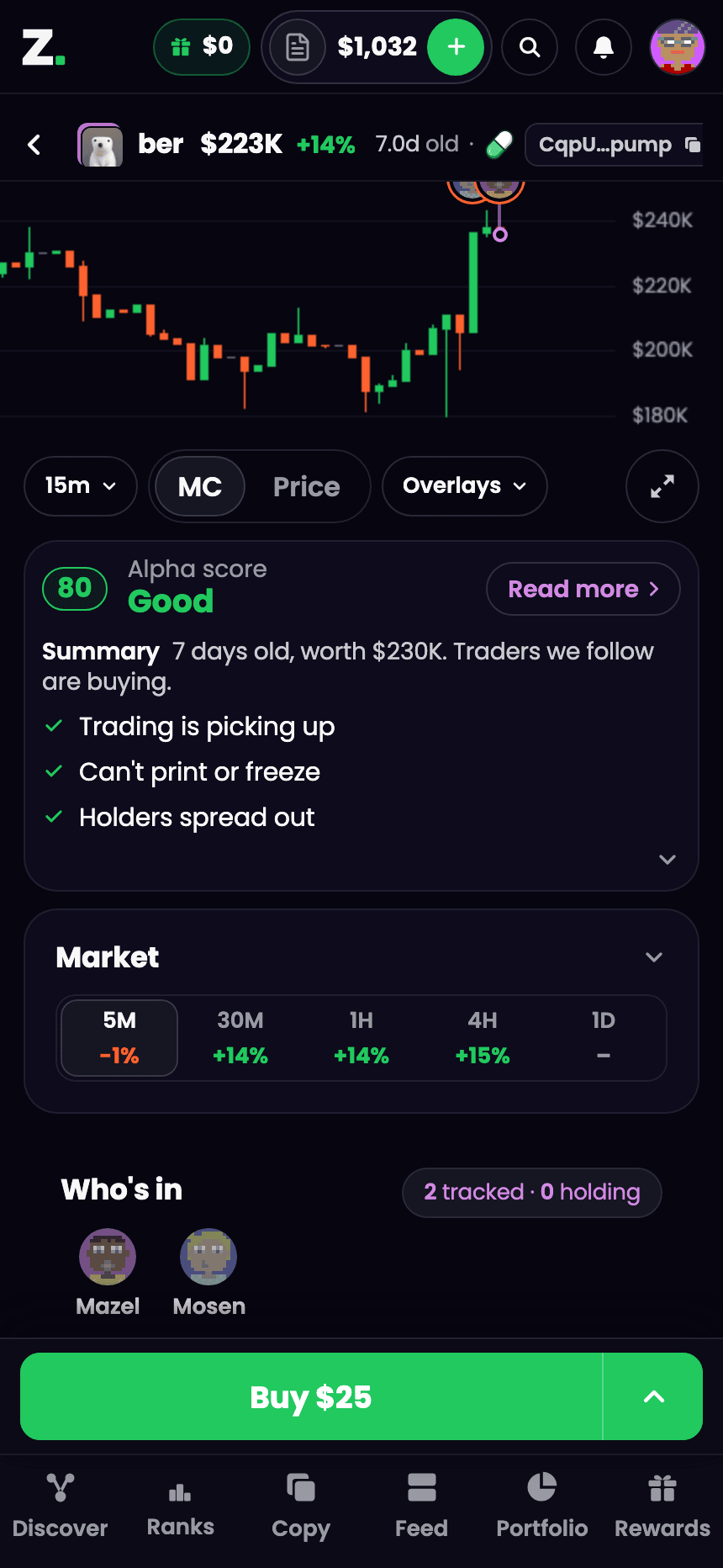 The Alpha score on a phone token page. Check it in the line at the shop.
One more pill to know: Big swings shows when the odds of a 50% drop inside 10 minutes are about even or better. It measures how wild the price is, not how good the token is. It is grey, and it never touches the score.
What it does not promise
- A high score is not a profit. Good tokens dump. Tracked traders get it wrong too.
- A low score is not a rug. It means more is against it right now than for it.
- It is a set of rules we wrote, points for and points against. Not a crystal ball.
- It moves. A Good at your entry can be Risky ten minutes later.
- Copy Trade and your exits never look at it. Nothing trades on the score for you.
The Alpha score is not financial advice.
Before you send it
- Read Against before For. One heavy line beats three nice ones.
- See a 25 or lower? Open the sheet and check the Red flags bar. Points off there mean a red flag is holding it down, and red flags are where the rugs hide.
- Watch the Callers bar. "Callers hyped, then sold" is the oldest exit-liquidity play there is.
- Set Alpha, at least to 65+ in Filters to hide the scored tokens under 65. Tokens with no score yet stay on the list, so read those yourself.
- Watch the tokens you hold. The toast tells you when the word turns.