Memecoin calls: how to check a caller first
Memecoin calls are ads until the wallet says otherwise. Before you act on a call, check whether the caller bought, when they bought and whether they still hold.
A call costs the caller nothing to post and nothing to leave up after they sold. Nobody edits a post to say they are out.
So we read the wallet, not the words. This is how, on one token, in about a minute.
A tracked caller's wallets, alts included, on one page: the KOL wallet tracker.
Are memecoin callers legit?
Some are. Plenty of callers buy what they post and hold it. The problem is you cannot tell which from the post.
What a caller gains from a call is buyers. Buyers push the price up, and a caller who got in early can sell into them.
That is exit liquidity, and it is the oldest play in the trenches. It does not need a bad person. It only needs an early entry and a post.
Three questions sort the calls:
- Did their wallet buy? A call with no buy behind it is an opinion.
- When? Bought well before the call, the post may be their exit window.
- Do they still hold? A bullish call from a wallet that sold out is the pattern to walk from.
Where crypto calls show up in clusterz
You do not need a Telegram group. Calls land in the app:
- Feed, Callouts tab: posts marked as callouts, plus calls from the callers and accounts clusterz tracks. Each card shows the market cap and how far it has moved since the post. See Callouts.
- Trending in the feed, on the Feed's right column: up to six tokens named most in the last hour, with who posted and the move since the first call.
- Trending, the Callouts column: how many callouts a token has.
- The Map: a callout pops a speech bubble off the tile.
- Token page: the Callouts card on the right and the Callouts tab, with every post naming the token, newest first. Fetch latest checks for new ones.
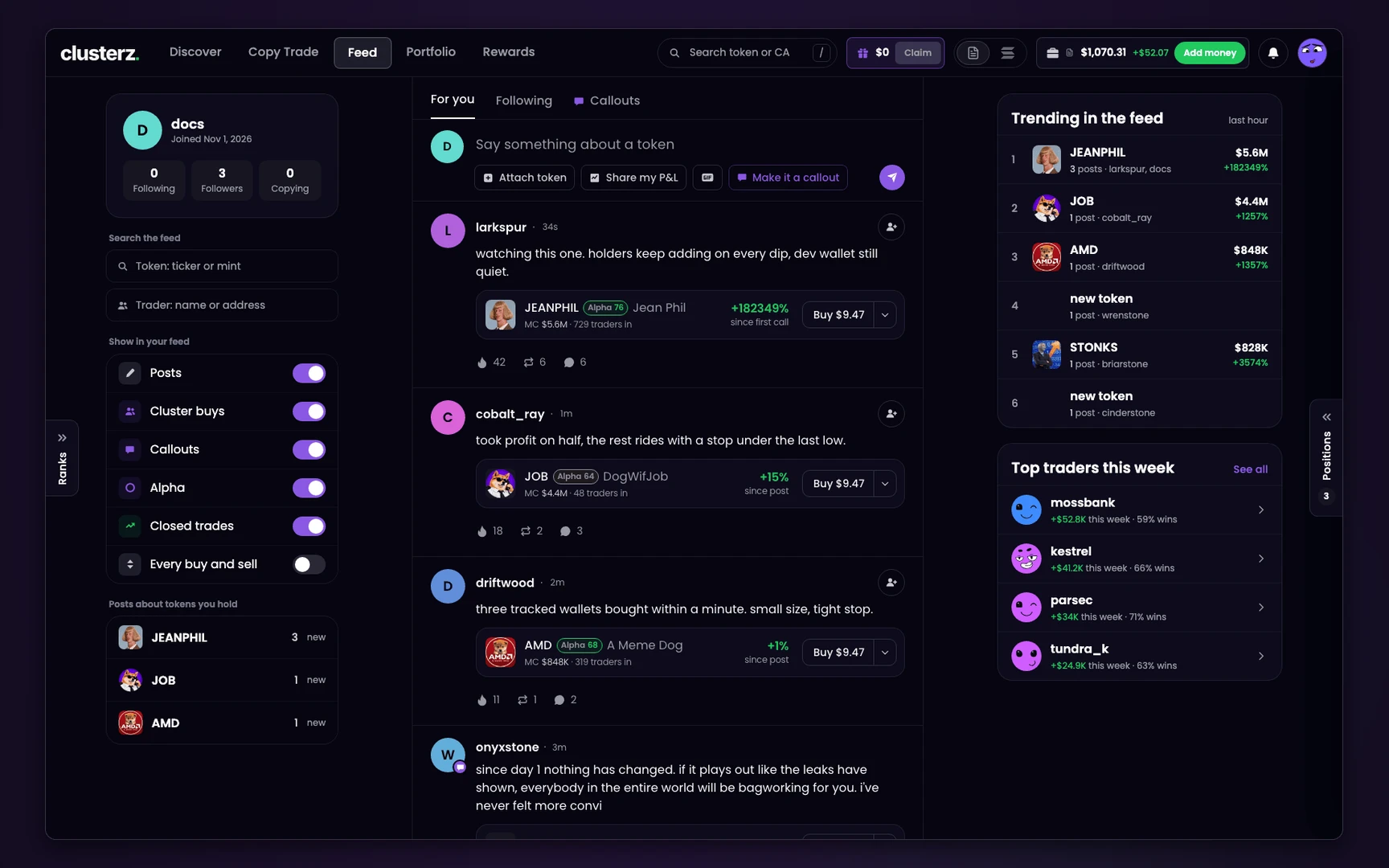 The Feed. Every call shows the move since it was posted.
Check a caller in four steps
Start on the token page.
- Read the callout rows. Open the Callouts tab. A row names the caller, and a tracked wallet beside the name with "N wallets" when we can tie them to one. No wallet beside the name means we have not tied the caller to a tracked wallet, so the call is words only.
- Did they buy, and when? Open Trades and pick Cluster. Read Market cap then and When for the caller's buys against the call's time. Bought far under the market cap at the post: they were early, and you are not.
- Do they still hold? Read Who's in. A caller who left is marked Sold. Then open their wallet page and read Holding on Positions, which adds up every wallet we link. See Wallets.
- What did the other callers do? The top of the Callouts tab counts them: "4 callers: 3 bullish, 1 bearish". Under it, in red, "2 posted it bullish, then sold". Or "2 sold out". That line is the one to read.
On a caller's call, the holding and P&L printed on the row come with the post. They can be a snapshot from when it went up. Who's in and Positions are our read of the wallets now. When they disagree, go with the wallets.
Callers hyped, then sold: the Alpha score's caller lines
The Alpha score has a Callers group, and it writes what callers did in plain words:
| Line | What it means |
|---|---|
| "Callers still holding" | The callers who posted it still show a holding |
| "Callers are bullish" | Their overall mood reads clearly bullish |
| "Callers posted it" | Called, nothing more to say |
| "Callers are bearish" | Their overall mood reads clearly bearish |
| "Callers hyped, then sold" | Callers whose words read bullish, and whom our tape saw sell out |
| "Callers already sold" | Callers we saw sell out, whatever they said |
The points:
- Anyone calling it adds 2. A call alone moves the score up, so do not read a small bump as proof.
- "Callers hyped, then sold" takes 8 off when 3 or more callers did it and they make up at least half of everyone who called the token.
- At 2 or more, the score's summary can lead with "Callers hyped it, then sold."
Find them under Against in the sheet, or as the Why on a Trending row. Watch the Callers bar in What makes the score: points off there are the caller story in one number.
Best memecoin callers: judge them over weeks, not one call
One good call proves nothing. A caller's record does.
- On their wallet page, read Results on 30d before 7d. A hot week is not a record.
- On Positions, open Callouts for their posts with the market cap at the post and now. Line each one up with their trades.
- Count how often they sold after the post. A caller who does it every time is telling you what the post is for.
The full method for a wallet page: How to read a KOL wallet. For how alts hide the selling: What is a KOL wallet.
What a caller check cannot catch
- Callers we do not follow. Calls in the app are Feed callouts and calls from the callers and accounts clusterz tracks. A Telegram group's call is not in the app.
- Wallets we have not linked. "Callers hyped, then sold" counts only callers whose trades our tape saw. A caller selling from an unlinked alt reads as still holding, or as words only.
- Words read as words. A caller whose trades we never saw is counted bullish or bearish on what they wrote. That is a reading of a post, not of a wallet.
- X posts we did not collect. They show only when we collect them.
- The next minute. A caller still holding now can sell before your buy lands.
- Honest mistakes. A caller who buys, holds and still loses is not a scammer. They are just wrong, and you are wrong with them.
A clean caller check promises nothing. It only means you know who you are buying from.
Before you send it
- No buy behind the call? Treat it as an opinion.
- Bought far under the post's market cap? You are late. Size like it.
- Sold in Who's in, or "posted it bullish, then sold" in the tab: walk.
- Read Against for the caller lines before you read anything nice.
- Then run the token itself through a rug check. A caller can be honest about a bad token.
- Watching the wallets live instead of the posts: How to read the clusters map.