What is a sandwich attack? MEV on Solana explained
A sandwich attack puts a buy just before your swap and a sell just after it, so you fill worse and the attacker keeps the gap. It is one kind of MEV.
You never see the attacker. You see a fill a bit worse than the quote, and you blame the token.
What MEV means on Solana
MEV stands for maximal extractable value: money someone can make by choosing the order of transactions in a block, or by putting their own next to yours. Some of it is harmless.
An arbitrage bot that brings two pools back to the same price is MEV. So is a liquidation.
The kind traders hate is the kind that takes from them. A sandwich is the classic one.
Solana has no public waiting room for transactions the way Ethereum has. But a transaction still passes through hands before it lands: the RPC that forwards it, the leader that schedules it, and anything in between.
Whoever sees it before it lands, and can place trades around it in the same block, has the chance to sandwich it.
How a sandwich attack works
Three trades, in this order, all in the same block:
- The front. The attacker sees your buy coming and buys the same token first. The price goes up.
- You. Your buy runs at the higher price. You get fewer tokens than the quote said. Your buy also pushes the price up further.
- The back. The attacker sells right after you, into the price your buy created. They keep the difference.
The attacker needs one thing from you: room. Your slippage limit says how far the price can move before your trade fails.
The attacker pushes it as close to that line as they dare. If they push past it, your trade fails and their front leg is left holding the token.
So the size of the bite is set by you. A 5% limit gives them at most 5% to work with. A 50% limit gives them half.
Why sandwich attacks matter to a trader
- It looks like normal slippage. No error, no warning. The fill is just worse, every time, by about the most you allowed.
- Memecoins are prime targets. Thin pools and wide slippage settings mean a small front trade moves the price a lot.
- Bigger trades are juicier. A sandwich on a tiny buy may not pay for the attacker's own fees. A big buy with a wide limit is the jackpot.
- It compounds with fees. You pay the pool fee, the network fee and the tip on top of the worse price.
- Sells can be hit too. Same pattern, reversed: they sell before you, you sell lower, they buy back after.
How to avoid getting sandwiched
You cannot make it impossible. You can make yourself a bad target.
- Keep slippage tight. This is the one setting that caps what a sandwich can take. Go wide only on a token that is moving so fast you accept the worse fill anyway. See what is slippage.
- Size for the pool. Your own price impact is part of the room. A buy that moves a thin pool 15% on its own needs a wide limit to fill, and a wide limit is the invitation. See market cap vs liquidity.
- Split big trades when the pool is thin, if you can live with a slower entry.
- Don't spam retries with a raised limit. A token you are chasing at 40% slippage is a token you are overpaying for, sandwich or not.
- Read your fills. Compare what you got against the quote. A pattern of fills right at your limit is worth noticing.
What none of this catches: a front trade that stays inside a tight limit still takes a small bite, and an attacker can always outpay you on ordering. A tight limit bounds the damage. It does not end it.
What "MEV protection" usually means
Plenty of tools sell "MEV protection". On Solana it usually means sending your transaction along a route meant to keep it out of view until it lands, often through Jito's block engine.
Jito's own docs describe its send method as giving MEV protection by default.
Read the claim carefully. A protected route narrows who can see your trade early. It does not change your slippage limit, the pool you trade against, or the trades around yours that you never see. No route makes a wide limit safe.
Where this shows up in clusterz
We make no MEV-protection promise, and we are not going to start here. What you control in clusterz are the two settings that matter:
- Max price move in Trade settings. This is your slippage limit on Live trades: 5%, 10%, 20% or 30%, or your own value. It starts at 10% and turns amber above 25%, because past that a fill can be far worse than the price you see. See Trade settings.
- Speed, the Jito tip. It helps a trade land sooner. It is not a shield, and we do not sell it as one. See priority fees and Jito tips.
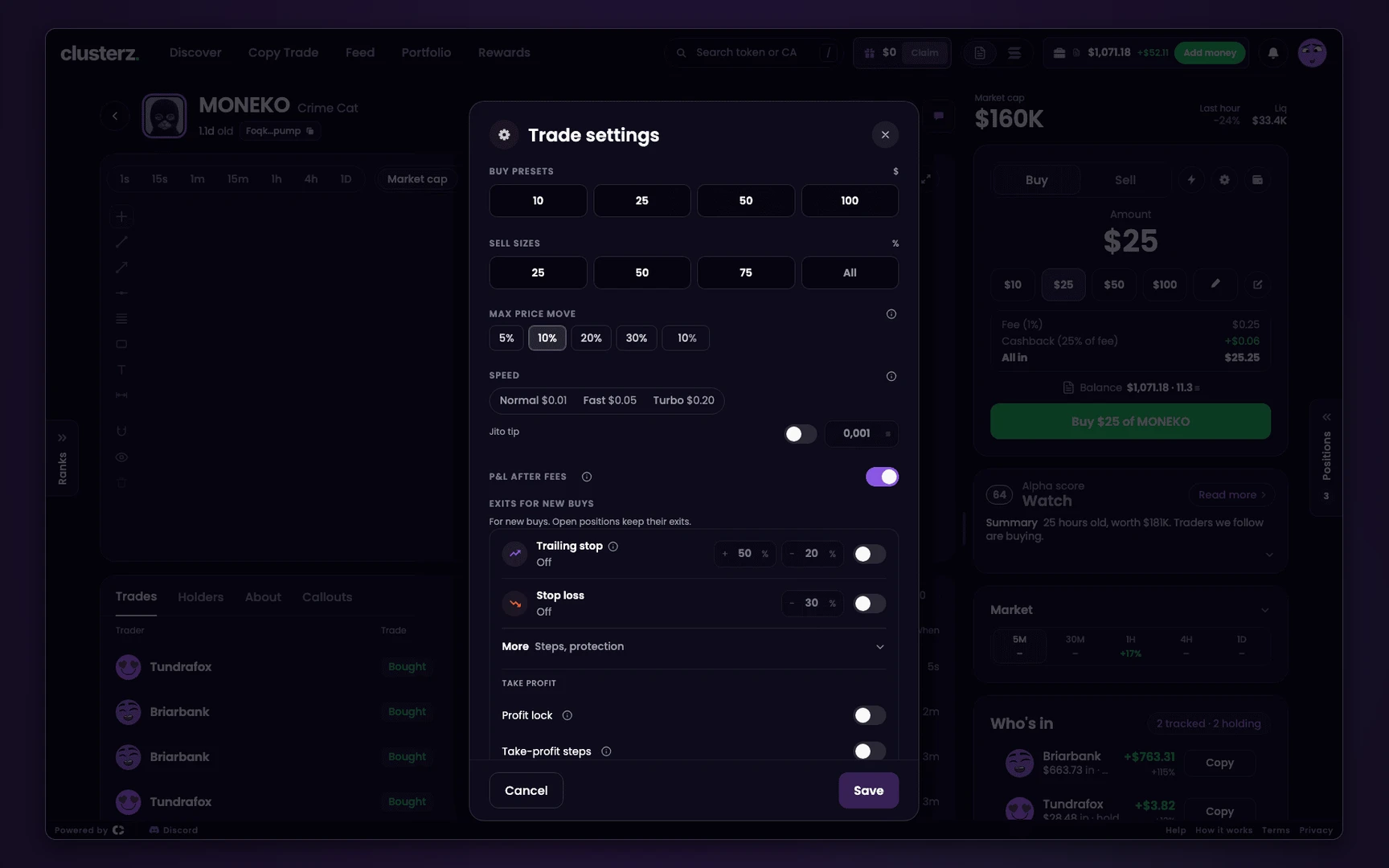 Max price move caps how far a fill can slip. Speed is the tip.
Copies have their own Slippage in More settings, starting at 20%. A copy that lands late already buys higher than the trader it copies, and a wide limit on top widens the gap. Keep Skip if later than short. See Copy Trade.
Your exits sell at market too. A stop loss on a thin pool can fill past its level in a fast dump, sandwich or not. The toast shows the real return when that happens. See Exits.
Sandwich attack FAQ
What is a sandwich attack in crypto?
It is a trade placed right before yours and another right after, in the same block. The first pushes the price up so you buy worse, the second sells into the price your buy created.
The attacker keeps the gap, up to the slippage you allowed.
Does MEV exist on Solana?
Yes. Solana has no public mempool like Ethereum's, but transactions are still seen before they land by whoever forwards and schedules them. Arbitrage, liquidations and sandwiches all happen on Solana.
How do I avoid getting sandwiched on Solana?
Keep your slippage limit as tight as the token allows, size your trade for the pool, and do not chase a running token by raising the limit again and again. That caps what a sandwich can take. Nothing removes the risk entirely.
Does a Jito tip protect against sandwich attacks?
A tip buys a better place in Jito's auction so your trade lands sooner.
Sending through Jito's block engine is often marketed as MEV protection, but it does not change your slippage limit or the pool you trade into. Treat a tip as speed, not as protection.
Is high slippage dangerous?
It is the room an attacker works in. With a 50% limit, your swap still goes through after the price was pushed most of the way to that line, and a sandwich can take a large share of the trade. Raise it only when you accept the worse fill.
Sources, checked 5 November 2026
- Jito Labs docs, Low Latency Transaction Send: the block engine, bundles and tips, and the statement that its sendTransaction method submits with MEV protection by default.