What is copy trading in crypto? How it works, and risks
Copy trading means a bot buys and sells when a wallet you follow does. It runs on public trades. It can work, but a copy buys later, higher and smaller.
Copying a wallet copies its decisions, not its entries. The gap between the two is where most copies lose.
How ours works, on one page: the Solana copy trading bot for memecoins.
What copy trading is in crypto
On Solana every trade is public. A wallet buys a token, and anyone watching the chain sees it within moments. Copy trading turns that into a rule: when this wallet buys, buy too. When it sells, or when my own exit hits, sell.
You pick who to follow: one trader, a group of traders, or a dev who launches tokens. You pick your size. The bot does the rest, day and night.
That is the whole idea. It sounds like a shortcut to someone else's edge. Sometimes it is. More often, the edge was in being first, and being first is the one thing a copy cannot do.
How copy trading bots work
A copy bot does three jobs:
- Watch. It reads the chain, or a fast stream of it, for trades from the wallets you picked.
- Decide. Each trade goes through your rules: is it a buy, is it a venue the bot can trade, is the token too old or too big, did the trade land too long ago, is there SOL left.
- Send. It builds and sends your own buy, then watches for the trader's sell or your exits.
Every step takes time. The trader's buy has to land and be seen. Yours has to be built, sent and land. On a calm token that is fine. On a fresh launch, the price can be far higher by the time your buy runs.
The fastest copies try to land in the same block as the trader. That is a race against everyone else watching the same wallet.
Is copy trading profitable?
Sometimes, for some traders, at some sizes. A trader's own P&L tells you little. What matters is what a copy of them would have made, after the delay and after costs. Those are different numbers, and the second is usually smaller.
The ways a copy loses money:
- Late fills. You buy after them, so you pay more. On a launch, half a second can be the difference between their entry and their exit.
- Being exit liquidity. A trader who sells into the buyers his own buy attracts is selling into copiers too. Your copy is part of the crowd he needs. See exit liquidity.
- Copying the wrong wallet. Many traders run alt wallets. Copy the public one and you may buy as the alts sell. The wallet you see can still be holding while the rest of the cluster is out.
- Size mismatch. A whale's 20 SOL buy barely moves him. Your copy at a share of his size might be fine, or might be far bigger than the pool can take at a fair price. Fixed sizes don't scale with conviction.
- Fees. Pool fees, network fees and tips, both ways, on every trade. On small sizes they eat most of the edge.
- Slippage. Copies run wide slippage so they fill at all. Wide slippage fills worse. See what is slippage.
- The trader changes. A record is history. Styles change, luck runs out, wallets get abandoned.
Copy trading risks you can't set away
- A bot runs while you sleep. That is the point, and it is also the risk. It keeps buying until a limit stops it.
- Custody. A copy bot has to sign trades without you. Somebody holds that key. Know who, and what the money in it can do.
- Rugs fill below any stop. A stop loss sells at market. If the pool is drained, there is no market.
- Practice flatters. Simulated copies never lose a race to land. Expect real results to be worse.
What to check before copying a trader
- What a copy made, not what they made. If the gap is wide, the money was in being first.
- How fast you need to be. If they only look good when copied in the same block, you need to win the block every time.
- How they sell. A trader who sells within seconds leaves a copy holding the top.
- How many wallets they use. Buying on several wallets moves the price before your copy gets there.
- Where they trade. A copy can only follow trades on venues it supports. The rest are skipped, and each skip has its reason in copy logs.
- Your worst day. Pick the loss you are fine with before the first buy.
None of this makes a copy safe. It tells you which copies are likely to lose fastest.
How copy trading works in clusterz
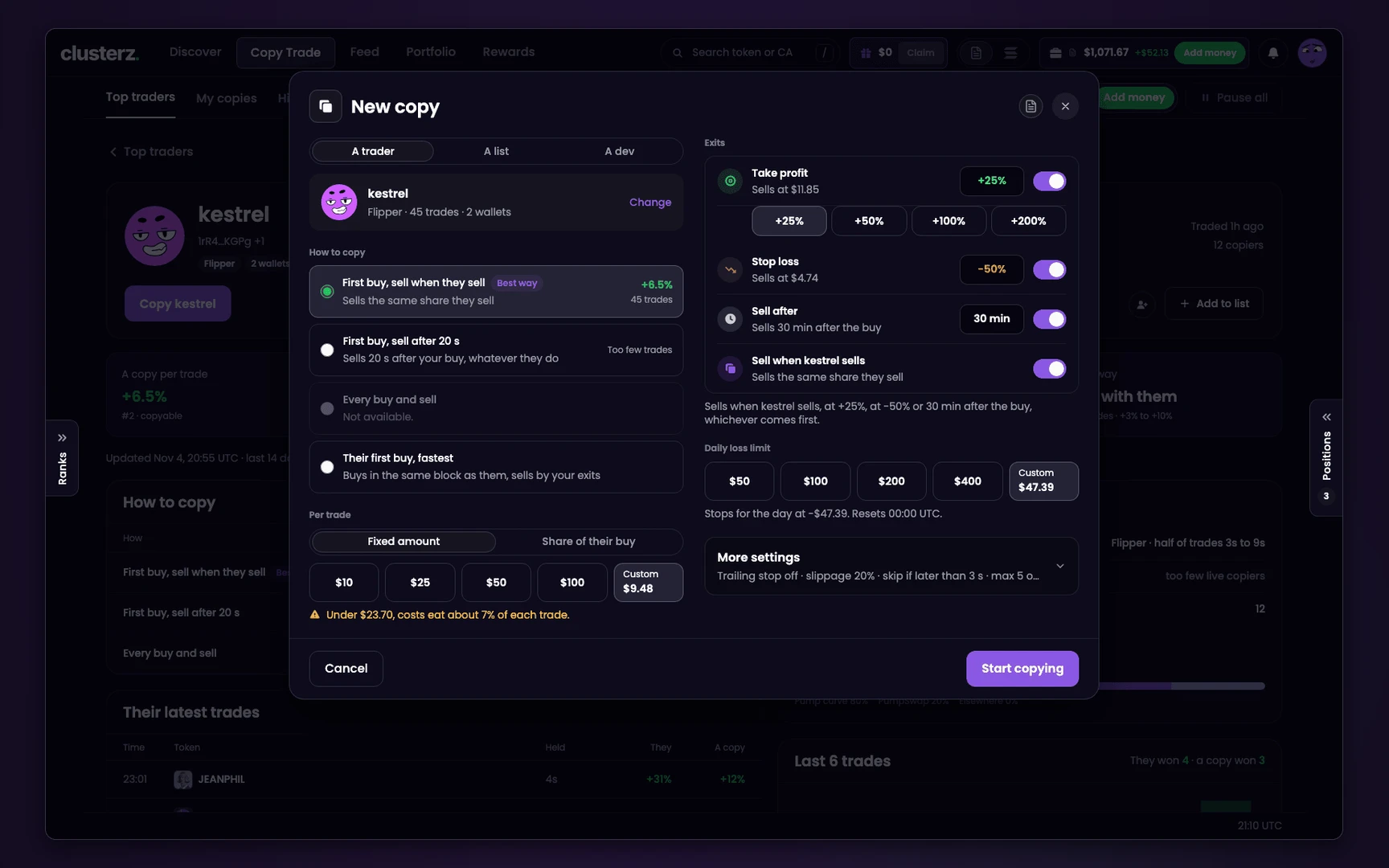 The setup says what costs take from each trade, before you start.
The full product is on Copy Trade. The step by step is your first copy trade. The short version of what applies here:
- What a copy made. Top traders ranks by Per copy, what a copy made per trade. A trader page shows How to copy: what each way would have made buying in the same block, and half a second late, after costs at 0.1 SOL per buy. See Find a trader.
- Late copies skip. Skip if later than starts at 3 s for a copy of a trader and 2 s for fast, together and dev copies. A buy that lands that late is you buying their top.
- Alts. A fast copy of a trader watches up to 20 of their wallets. A together copy buys only when 2 or more of a list's wallets buy in the same block.
- Size. Fixed amount or Share of their buy, capped by Max per trade.
- Fees. Copies pay our 0.2% fee on each buy and sell, not the 1% on trades you place. The line under the size adds up every cost. At 0.1 SOL per trade they come to about 5%. Under 0.25 SOL it turns amber. See Fees.
- Daily loss limit. Once the day's sold positions are down that amount in total, wins minus losses, the copy stops buying until 00:00 UTC. It starts at 0.5 SOL for a copy of a trader or a list, 0.25 SOL for fast, together and dev copies. Open positions still sell by their exits. See Daily loss limit.
- Venues. A copy of a trader only follows buys on pump.fun and PumpSwap. In Live every copy buys on the pump.fun curve only. See Limits.
- The Copy wallet. In Live, copies buy from a separate Copy wallet that our server holds, so copies can buy while you sleep. Its key cannot be exported, and SOL in it can only go back to your own wallets. Your Main wallet stays yours and a copy never spends from it. See Your wallets.
- Practice first. Copies run in Practice on play money against the live market. Practice copies pay less than Live ones, so read a Practice result as the top of the range. See Practice to Live.
Copy trading FAQ
What is copy trading in crypto?
It is a bot that buys and sells when a wallet you follow does, at a size you set. On Solana it works because every trade is public on the chain. You copy the decision, not the price they got.
Is copy trading profitable?
It can be, but a copy usually makes less than the trader it copies. You buy later and higher, you pay fees both ways, and you may be part of the crowd they sell into.
Judge a trader by what a copy of them made, after costs, not by their own P&L.
What are the risks of copy trading?
Late fills, buying as the trader or his alts sell, sizes that don't fit the pool, fees that eat small trades, and a bot that keeps buying while you sleep. A daily loss limit caps new buys, not the loss on bags still open.
How do copy trading bots work?
They watch the chain for the wallets you picked, run each trade through your rules, and send your own buy. They then sell when the trader sells or when your exits hit. The fastest try to land in the same block as the trader.
Can you copy trade on Solana with clusterz?
Yes. Copy Trade copies a trader, a wallet list or a dev, in Practice or Live, with your own size, exits and daily loss limit. Start with your first copy trade.