Solana priority fees and Jito tips explained
A priority fee pays the Solana leader to schedule a trade sooner. A Jito tip pays validators on Jito's network. Both help a trade land, neither guarantees it.
On a quiet token you never think about either. On a launch everyone wants, they decide who gets the entry and who gets the top.
What a Solana transaction fee is made of
Every Solana transaction pays a fee in SOL. Solana's own docs split it in two:
- The base fee. A fixed amount per signature, 5,000 lamports, which is 0.000005 SOL. Half is burned, half goes to the validator. A normal swap has one signature, so this part is tiny and does not change.
- The priority fee. Optional. You set a price per compute unit, and the fee is that price times the compute units your transaction asks for. All of it goes to the validator.
The base fee gets you in the queue. The priority fee moves you up it. When blocks are calm, a small priority fee is plenty.
When everyone is trading the same new token, the leader sees a lot of transactions fighting over the same accounts, and the ones paying more for each unit of work tend to go first.
What a Jito tip is
Many Solana validators run Jito's version of the validator software.
It connects to Jito's block engine, which takes transactions and bundles from traders, bots and apps, runs an auction on tips, and hands the best paying ones to the validator.
A Jito tip is a plain SOL transfer inside your transaction to one of Jito's tip accounts. Validators and their stakers collect it. It is separate from the priority fee and goes through a separate auction.
Jito's own docs say a minimum tip may not be enough at busy times and tell senders to set both a priority fee and a tip.
So a fast Solana trade usually pays three things: the base fee, a priority fee, and a tip. Only the tip is yours to pick in clusterz. The rest is set for you.
How much to tip on Solana
There is no right tip, only a price for the odds on a given block. What changes the answer:
- How hot the token is. A launch with hundreds of wallets buying in the first seconds is an auction. A token nobody is touching lands fine with no tip.
- How much the entry is worth to you. A tip is a fixed SOL amount, not a percentage. On a 0.05 SOL trade a big tip is a big share of the trade. On 5 SOL it is noise.
- Both sides. If you tip to get in, you probably want to tip to get out. Count the tip twice.
The trap is small trades. Tip, priority fee, pool fee and our fee on the way in, then all of them again on the way out. Below a quarter of a SOL, costs start eating the trade. See Fees.
The tip next to slippage, size and exits, by situation: the best settings for trading Solana memecoins.
Why is my Solana transaction slow?
A trade that sits on "confirming" or never lands is usually one of these:
- Busy blocks. Lots of traders on the same token. Your priority fee or tip was outbid.
- The send was late. A transaction is built against a recent block. Wait too long and it expires, and the network drops it. Nothing is spent.
- The price moved. It landed, but failed on your slippage limit. That is a different problem. See what is slippage.
- Network trouble. The whole chain or your connection to it is struggling. More tip does not help that.
A higher tip shifts the odds on the first one. It does nothing for the other three.
Why speed matters to a trader
- Seconds are price. On a fresh launch, landing one block later can mean buying after the snipers. The chart can be up double digits by then.
- Landing first is not the same as winning. The wallets that beat you are often the ones you would be selling to. Being fast into a bundled launch just gets you in faster. See bundles and insiders.
- Tips are a cost you pay on every trade. Win or lose. A tip habit on tiny trades is a slow bleed.
- Exits need to land too. When a token dumps, everyone sells at once. A sell stuck in a crowded block sells lower.
Where you set speed in clusterz
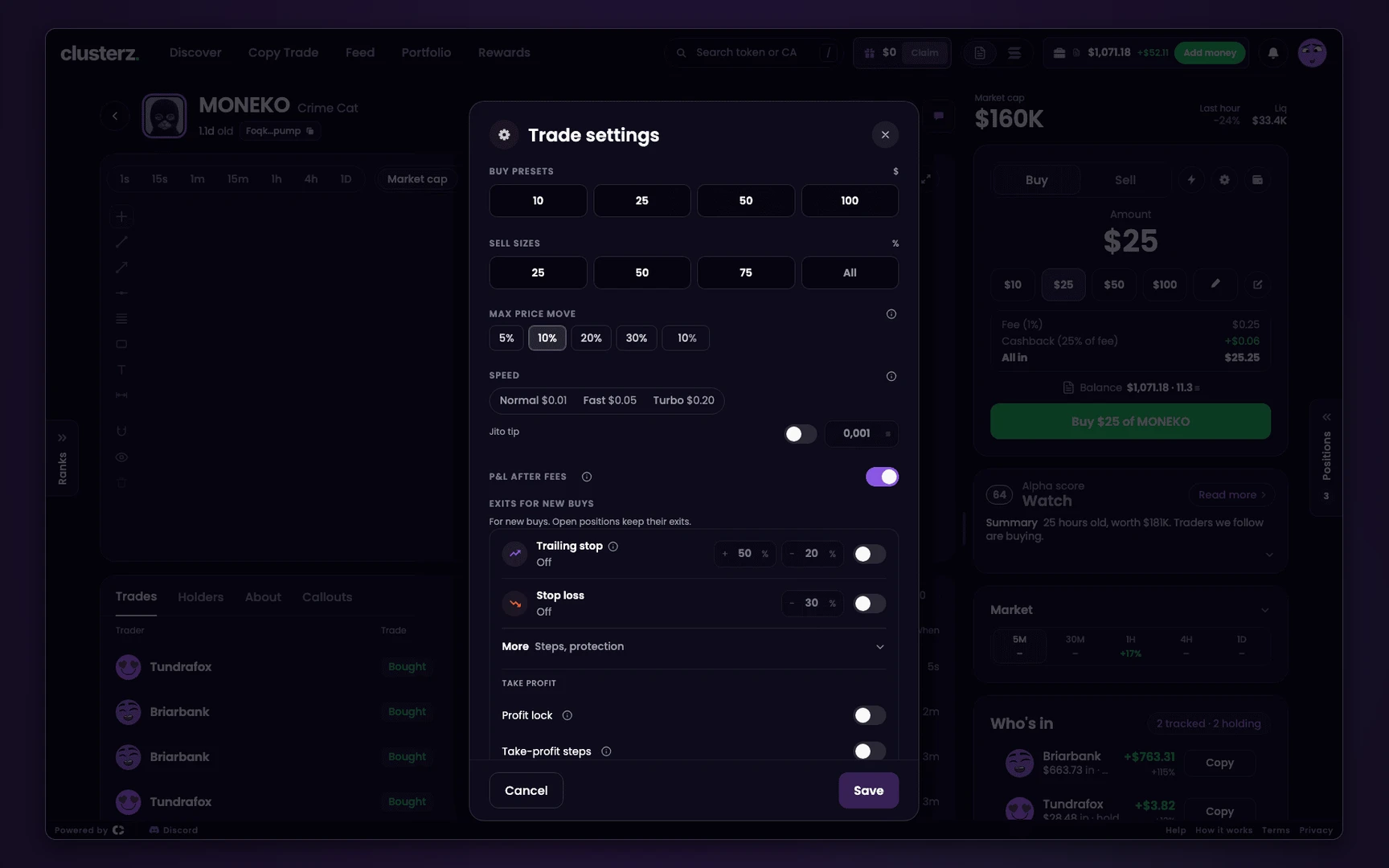 Speed sits under Max price move in Trade settings.
Open Trade settings from the gear on a token page. The Speed row is your Jito tip. See Trade settings.
- Normal, Fast and Turbo are tip presets of about 0.01, 0.05 and 0.20 USD, paid in SOL at today's price.
- Or switch on Jito tip and type your own, from 0.0001 to 0.01 SOL.
- Speed is off by default. Off means no tip on your trades.
- It is paid on each Live trade you place, buy and sell. A trade under 0.05 SOL pays at most 0.0002 SOL. A route that cannot carry a tip pays none.
The priority fee is ours to set, and we set it. It is a small SOL amount that moves with how busy the network is. None of it, and none of the tip, comes to us: both go to the network. See the network's cut.
Copies and snipes keep their own tip. In a copy's More settings, Jito tip starts at 0.001 SOL, from 0.0001 to 0.01 SOL, paid on each buy and each sell. Your Trade settings tip does not touch it. See Copy Trade.
Practice never sends to the network, so there is no race to win and Speed does not make a Practice fill faster.
Practice fills still pay a priority fee, worked out from a live quote when there is one, so a play trade is not free. See Practice and Live.
A Live trade still landing after a while shows "Still confirming" in amber. No answer within a minute reads "No word on" the trade, with a link to check your wallet. That means we lost sight of it, not that it failed. See Troubleshooting.
What we do: Speed off for normal trading. A tip only when trades are landing late on a token we really want, and never on dust. Speed next to every other setting: Settings explained.
Priority fee and Jito tip FAQ
What is a priority fee on Solana?
It is an optional extra on top of the base fee: a price you pay per compute unit, times the units your transaction uses.
It goes to the validator and helps your transaction get scheduled ahead of others. It is usually a small SOL amount that rises when the network is busy.
What is a Jito tip?
A Jito tip is SOL you send to one of Jito's tip accounts inside your transaction. Validators running Jito's software, and their stakers, collect it. It buys a better place in Jito's auction, on top of what the priority fee buys.
How much should I tip on Solana?
Tip for the token, not by habit. Quiet tokens need nothing. A crowded launch may need more, and even then a tip only improves the odds. Keep tips small against your trade size, and remember you pay them on the sell too.
Why is my Solana transaction taking so long?
Usually the block was crowded and other trades paid more, or the transaction expired before it got in. A slippage fail lands quickly but fails. If nothing lands for a long time, check your wallet on an explorer before you send again.
Does a bigger tip guarantee my trade lands first?
No. A tip raises your bid in an auction you cannot see. Someone can always pay more, and a tip does nothing when the price ran past your limit or the network itself is down.
Sources, checked 5 November 2026
- Solana docs, Fees: base fee 5,000 lamports per signature, split 50% burned and 50% to the validator; prioritization fee from compute unit price times compute unit limit, 100% to the validator.
- Jito Labs docs, Low Latency Transaction Send: Jito-Solana validator client, block engine, tip auction, tip accounts, and the advice to set both a priority fee and a tip.