Market cap vs liquidity: what MC and Liq mean
Market cap is a token's price times its supply. Liquidity is the money in its pools you can sell into. MC is what it is priced at, Liq what you can take out.
A $2M market cap with $40K of liquidity is not a $2M token. It is a $40K exit door with a big number painted on it.
What is market cap in crypto?
Market cap is the last price times the number of tokens. That is all it is. If one token last traded at $0.001 and there are a billion of them, the market cap reads $1M.
What it is not:
- Not the money that went in. Most tokens were bought far below today's price, many of them on a bonding curve for almost nothing. See what is a bonding curve.
- Not what holders could cash out. If every holder sold, the price would collapse long before most of them got paid.
- Not a measure of quality. A single buy into a thin pool can double it in a second.
Market cap is useful for one thing: comparing tokens, and comparing a token to itself over time. "Entered at 50K, now 400K" tells you more than a price with eight zeros in it.
What FDV means
FDV is fully diluted valuation: the price times every token that will ever exist, including ones that are locked or not minted yet. On a big project with tokens still unlocking, FDV can be far above market cap.
On pump.fun and most memecoin launchpads, the whole supply exists from the first second, so market cap and FDV are usually the same number.
When you see FDV on a memecoin screener, read it as market cap. The exception worth knowing is a Mayhem launch, where pump's bot mints a second billion on top of the normal billion.
What is liquidity in crypto?
Liquidity is what sits in a token's pools: the SOL, or other token, on one side and the token on the other. When you sell, you take SOL out of the pool. When you buy, you put SOL in.
Liquidity decides two things:
- How much your own trade moves the price. That is price impact. Sell 1 SOL of tokens into a pool holding 10 SOL and you move it hard. Sell the same into a pool holding 1,000 SOL and you barely notice.
- How much can come out at all. A pool can never pay out more SOL than it holds. Everything above that is paper.
Market cap vs liquidity: why the gap matters
Divide liquidity by market cap and you get a rough feel for how much of the number is real exit. A token with a high market cap and a thin pool is easy to pump and painful to leave.
Every big holder in it knows that, which is why so many of them need you to buy before they can sell. See exit liquidity.
Watch liquidity moving, not just its size. Market cap can hold while liquidity drains: someone pulled the pool, or big sells took the SOL out. The price chart may look calm right up until it doesn't.
Why can't I sell at the price shown?
The price on screen is the last trade. Your sell is a new trade, and it gets its own price. Four things stand between the two:
- Price impact. Your sell pushes the price down as it fills. The bigger the sell against the pool, the worse the average price.
- Pool fees. Every pool takes a cut. On pump.fun that is about 1.25% on each buy and each sell. See Fees.
- Everyone else. Other sells land before yours. In a dump, a lot of them.
- Your slippage limit. If the price runs past it, your sell fails instead of filling worse. See what is slippage.
And sometimes the pool simply cannot pay. A drained pool, or a curve with no SOL left in it, fills nothing whatever the price says.
Where you see MC and Liq in clusterz
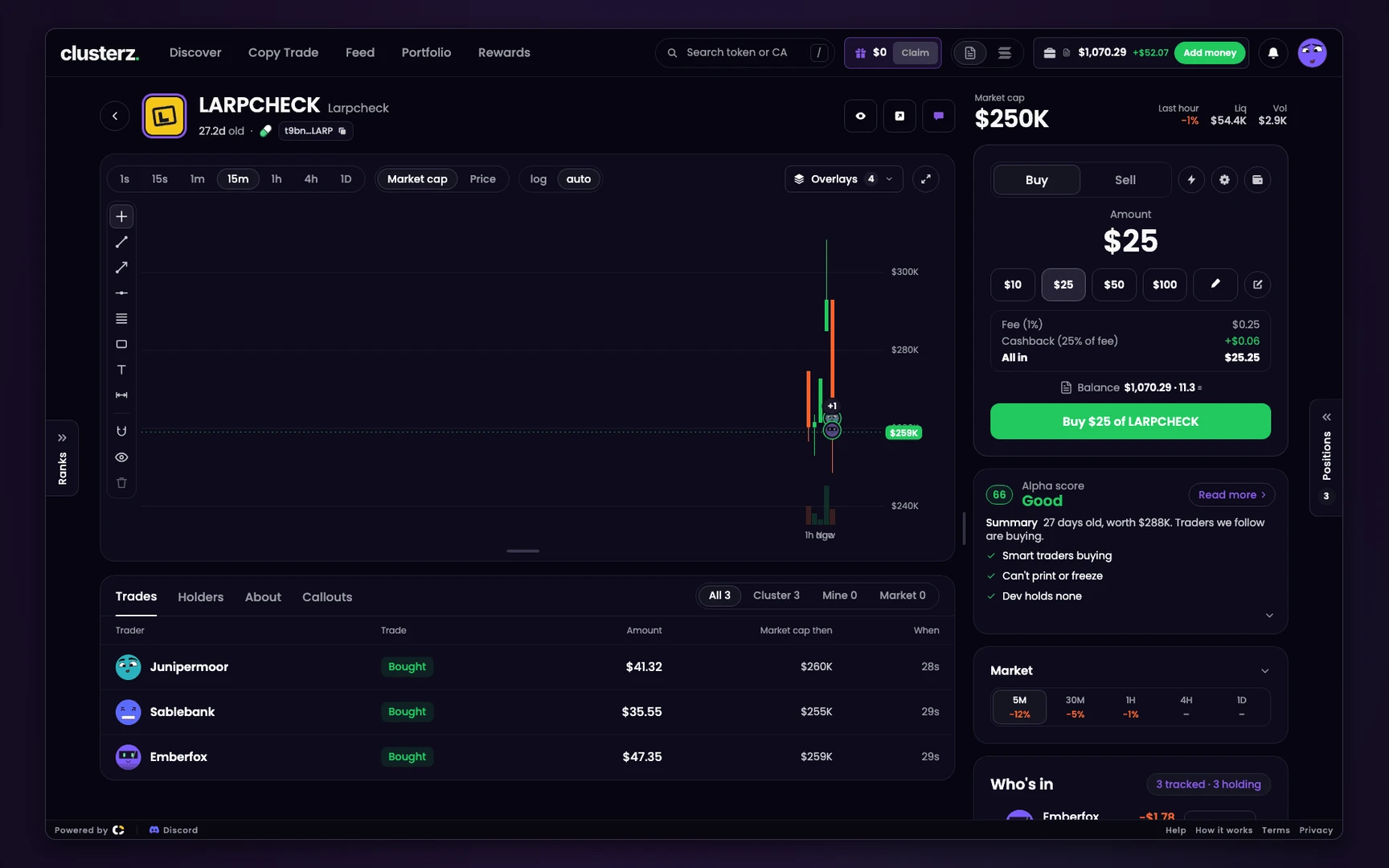 The token page opens with Market cap and Liq side by side.
- Token page. The right column opens with Market cap, its move over the Last hour, Liq and Vol. The chart can show Market cap or Price. See Token page.
- Trenches cards. MC sits on the right of every card, with TX, V and F. See reading a card.
- Trending. Market cap always shows. You can sort by MC and Liq, and More filters has a Liq box. See Discover.
- Bluechips and Stocks. Every row shows Liquidity and Market cap in USD. See Bluechips and Stocks.
A few rules that use them:
- Exit levels in market cap. You set a take profit or stop loss in percent, and the editor shows where it sits as a market cap, like "Sells all at about $508K market cap". Think in mcap, set in percent. See Exits.
- Pool drained. A protection rule that sells all if the token's pool loses 45% of its liquidity. Off until you turn it on. See Exits.
- Dead graduates. A graduated token whose market cap drops under 5 SOL leaves the Graduated column. Its pool got dumped to dust. See Trenches.
- Mayhem supply. A Mayhem token's market cap and top 10 share are counted on its 2 billion tokens, so it reads double an ordinary pump token at the same price.
When we have no figure, you get a dash or a faded placeholder. Never a made-up number.
What none of this tells you: who is about to sell. A healthy pool can still be drained by one holder. Read the holder checks too.
Market cap and liquidity FAQ
What is the difference between market cap and liquidity?
Market cap is the last price times the supply, a valuation. Liquidity is the actual money sitting in the token's pools. You can always sell into liquidity, at a price. You can never sell into market cap.
What does FDV mean in crypto?
Fully diluted valuation: the price times every token that will ever exist.
On projects with locked or unminted tokens it is higher than market cap. On a typical pump.fun memecoin the whole supply exists from launch, so the two are usually the same.
Is a high market cap good?
Not by itself. It says the last trade was at a high price, nothing more. Check liquidity against it, and check who holds the supply.
Why can't I sell my token at the price shown?
Your sell gets its own price. It pushes the price down as it fills, pays the pool fee, and lands after whoever sold first. On a thin pool all three are large. If the pool is drained, nothing fills at all.
How much liquidity is enough?
Enough that your own sell would barely move the price. Size your trade against the pool, not against the market cap. If selling your whole bag would move the pool hard, you hold the same problem as the whales, with less to spend.