Top 10 holders: what holder concentration means
Top 10 holders is the share of a token's supply its ten biggest wallets own. High holder concentration means a few wallets can move the price. What is high.
A token is worth what the next buyer pays. When ten wallets own half of it, those ten decide what the next buyer gets.
Top 10 holders, checked on every new pair's card: pump.fun new pairs, live.
What top 10 holders means
Top 10 holders meaning, plainly: add up what the ten largest wallets hold and divide by the total supply. If those ten own 41% of a billion tokens, the top 10 share is 41%.
It is the fastest way to see holder concentration: how much of the token sits in a few hands. The higher the share, the fewer sellers it takes to crash the price.
Holder distribution in crypto
Holder distribution is the shape of who owns a token. Two tokens with the same holder count can look nothing alike:
- Spread out. Thousands of wallets, none with much. No single sell moves the chart far.
- Top heavy. A long tail of small wallets and a handful of whales. The tail is noise. The whales are the market.
- One holder in disguise. Many mid-sized wallets that turn out to be one person. The distribution looks healthy until you link them. See wallet clusters.
On a memecoin the third shape is common, because a new wallet costs nothing. That is why the top 10 figure is a start, not an answer.
What should be left out of the top 10
Not every big holder is a person who can sell. A fair top 10 leaves out:
- The bonding curve. On a launch still on its curve, the launchpad's program holds the unsold tokens. That is stock for sale, not a holder.
- The pool. After graduation the pool holds a large share. It is the market itself.
- Burned tokens. Tokens sent to a burn address can never sell.
Count those in and every token looks dangerous. Leave them out and you see wallets that can actually dump on you.
Why holder concentration matters to a trader
- Few holders, big sells. One whale with 8% can sell into a thin pool and take the price down further than your stop.
- They often got in cheap. Large holders on a new launch are usually early: the dev, a bundle, snipers. Their entry is far under yours.
- A low share can still hide one bag. Ten wallets at 3% each read as 30% held by ten people. If they share a funder, it is one person with 30%.
- It changes by the minute. Holders sell, buyers arrive, the share moves. Read it when you buy, not an hour before.
How clusterz measures the top 10
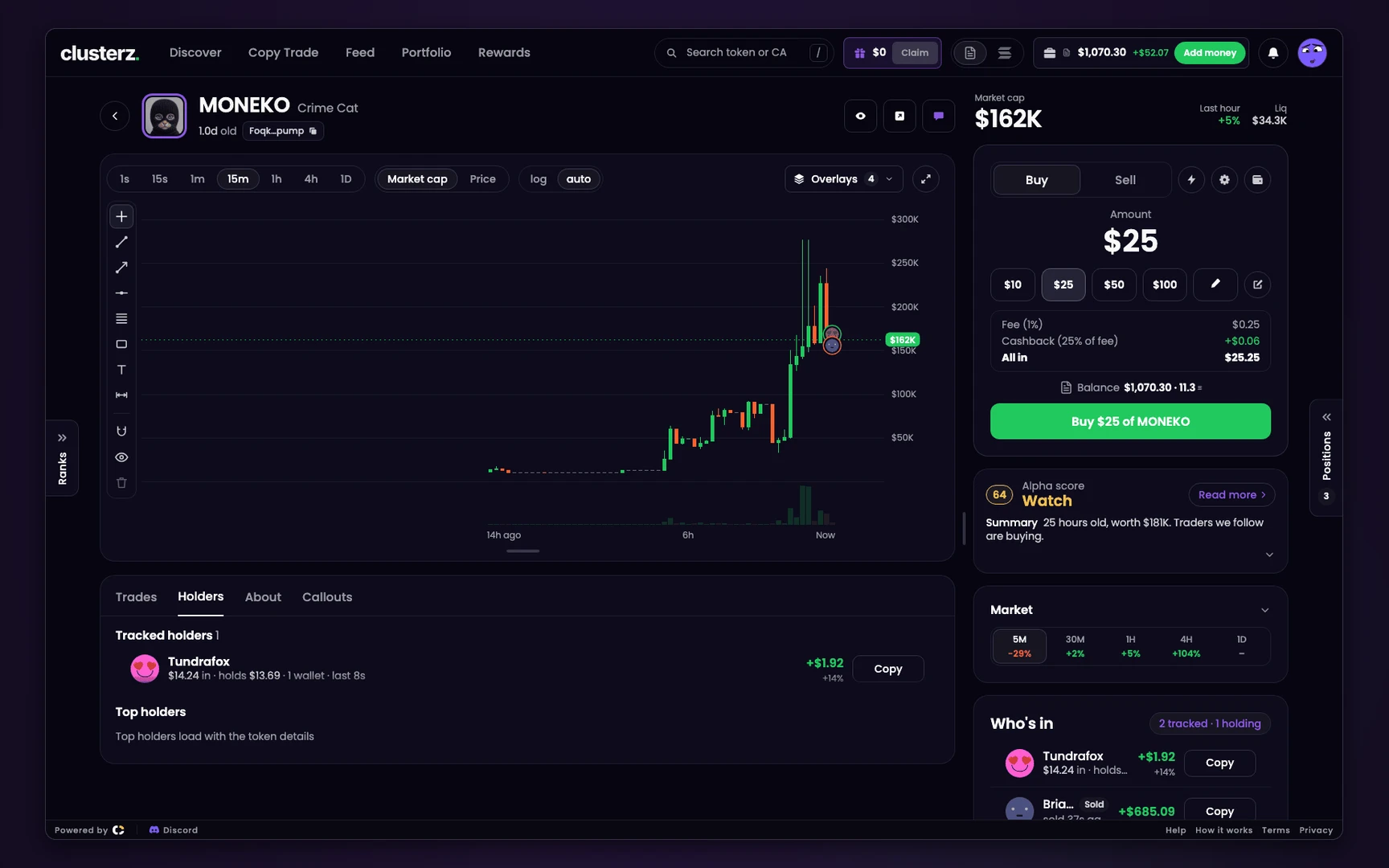 The Holders tab, with tracked wallets marked among the top holders.
- What it counts. The top 10's share of total supply, with the curve, the pool and burned tokens left out. So it is wallets that can sell.
- The Top 10 holders pill. First in the holder checks on every Trenches card, and under Indicators on a token page. Hover it: "Top 10 holders own 41%".
- The warning line. Over 30% the pill goes warning colour and Against reads like "Top wallets own 41%". From 30% up to 50% the Alpha score takes 12 points off.
- The red flag. At 50% or more the line is tagged High risk and the Alpha score cannot go above 25, however good the rest looks. See Alpha score.
- The good line. Under 30% reads "Holders spread out", with the share under it, like "10 wallets own 22%".
- All facts. Top 10 share with its figure, or Not read yet when nobody has checked. See Token page.
- The Holders tab. Tracked holders with their average entry, Top holders with tracked wallets marked, and Top traders 24h. See Token page.
- Filters. Top 10 holders sets a maximum share. In Copy Trade, Top 10 hold a lot under Skip a token when walks a copy past top-heavy tokens.
Two checks look past the top 10. Insiders reads the top 20 for wallets linked by funding and warns over 20%. Fresh wallets warns at 3 or more brand new wallets in the top 20. The step by step for both is in Bundles and insiders.
How many holders is good?
There is no good number. A holder count is cheap to fake: a crew can spread tokens over a hundred wallets in a minute. A real crowd and a farm can show the same count.
Read the count next to the shape:
- Many holders, low top 10, no insiders flagged. The supply looks spread. Still not proof.
- Many holders, high top 10. A crowd of dust around a few bags.
- Few holders, low top 10. Early, or nobody came. Check the age.
That is also why our Alpha score gives no points for the holder count itself. Where you see it:
- Cards. Holders sit on the second line of a Trenches card.
- Trending. Sort by Holders to put the biggest counts first. See Discover.
- Filters. Holders sets a minimum. Our Graduated launches with real volume setup asks for at least 100.
What none of this catches: holders linked by an exchange or a bridge, a bag split below the top 20, and tokens moved between wallets after you looked. A spread-out list promises nothing, and none of this is advice.
Top holders FAQ
What does top 10 holders mean in crypto?
It is the share of a token's total supply owned by its ten largest wallets. On clusterz the curve, the pool and burned tokens are left out, so the figure counts wallets that can actually sell.
What is a good top 10 holders percentage?
There is no line that makes a token clean. On clusterz the pill warns over 30%, and at 50% or more it is a red flag that caps the Alpha score at 25. Under 30% only means no ten wallets own a big share between them.
How many holders is good for a memecoin?
No count is good on its own, because wallets cost nothing to make. Read the holder count next to the top 10 share, the insiders check and the age of the token. Our Alpha score adds no points for holder count.
Does the top 10 include the liquidity pool?
It should not, and on clusterz it does not. The bonding curve, the pool and burned tokens are left out of the top 10 share, because none of them is a wallet that can sell on you.